The first time I attempted to make a quick dessert in a ceramic mug, the result was a rubbery, sponge-like mass that vaguely resembled a pencil eraser. It was a classic failure of understanding the system at play. I had tried to scale down a standard cookie recipe without accounting for how a microwave interacts with protein and moisture. The egg, which provides essential structure in a large oven-baked cake, became a tough, leathery binder when subjected to high-frequency electromagnetic waves. That disappointing evening launched a month-long investigation into the physics of the single-serving dessert.
My goal was clear: I wanted to engineer a cookie dough mug cake that possessed the molten, gooey heart of a fresh cookie while maintaining enough structure to be eaten with a spoon. Through forty-two test batches, I deconstructed the role of every ingredient. I looked at how fat behaves when heated rapidly and how different sugars influence the final crumb. I realized that for this specific application, we do not need the heavy protein of an egg. Instead, we need a precise chemical lift and a specific ratio of fats to flour.
This blueprint is the result of that optimization. It requires exactly three minutes of preparation and sixty seconds of cooking time. The total four-minute process yields a dessert that rivals anything coming out of a traditional oven. By eliminating the egg and relying on a calculated amount of baking powder, I solved the rubbery texture problem once and for all. You are not just making a snack; you are executing a high-speed culinary transformation.
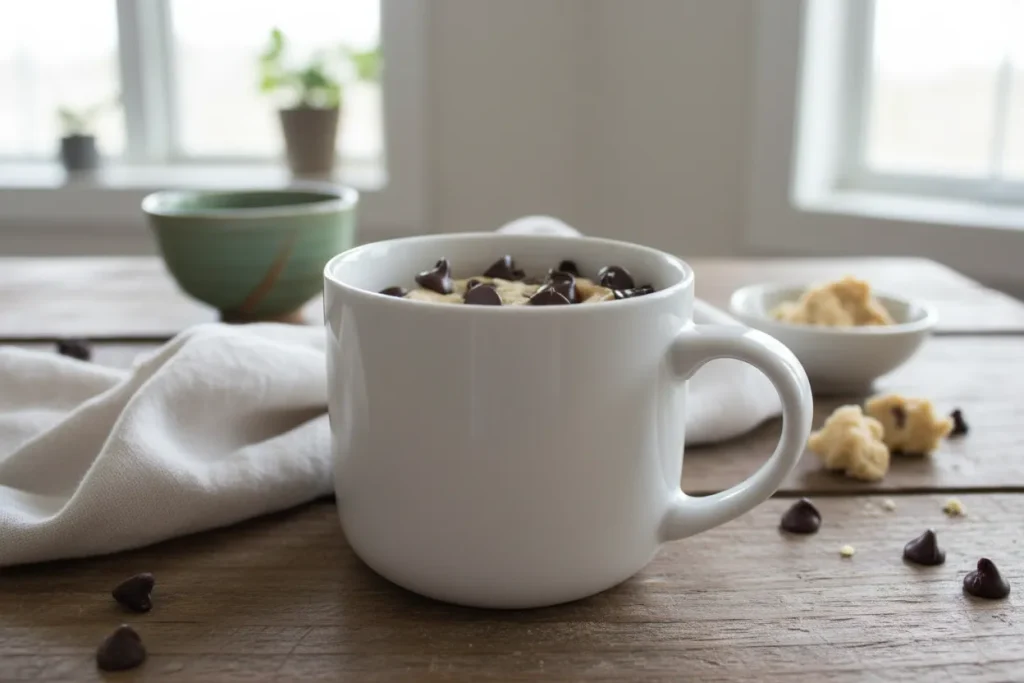
The aroma of this cookie dough mug cake is the first sign of success. As the butter melts and integrates with the sugars, a deep, caramelized scent fills the kitchen. It is a warm, inviting fragrance that signals the sugars are beginning to dissolve and the vanilla is blooming. When the microwave finishes its cycle, you will see a surface that has risen evenly with a soft, matte finish, studded with glistening pockets of dark chocolate.
Table of Content
The Critical Chemistry: Why Baking Powder Reigns Supreme When We Skip the Egg
When I began analyzing the structure of mug desserts, I focused on the role of the binder. In a traditional cookie, an egg provides leathening and emulsification. However, in a microwave environment, the proteins in an egg white denature and tighten almost instantly. This creates a dense, chewy texture that feels more like steamed bread than a cookie. By removing the egg, I removed the primary point of failure. This cookie dough mug cake relies on a different structural logic.
The architecture of this dish is built on the interaction between melted butter and baking powder. The butter provides the fat necessary to coat the flour particles, which inhibits excessive gluten development. This ensures the final product remains tender rather than tough. Because we lack the lift of an egg, the baking powder becomes the primary engine of aeration. It reacts with the moisture in the butter and the sugars to create tiny carbon dioxide bubbles.
My testing showed that a precise quarter-teaspoon of baking powder is the tipping point. Any less, and the dough remains a dense, oily paste that fails to rise. Any more, and the chemical aftertaste becomes detectable, ruining the delicate balance of vanilla and sugar. This specific ratio creates a crumb that is light enough to be pleasant but substantial enough to mimic the mouthfeel of underbaked cookie dough. This technique is similar to the structural logic required for my easy vanilla mug cake recipe.
The transition from a raw paste to a set cake happens in a matter of seconds. As the heat rises, the baking powder works to push the dough upward against the walls of the mug. The lack of egg means the structure is more fragile while hot, which is why the resting period is non-negotiable. During those sixty seconds of cooling, the starches in the flour finish setting, and the fats begin to slightly firm up, creating the perfect repeatable result.
Pro tip: Use a wide-bottomed mug rather than a tall, narrow one to allow the heat to distribute more evenly across the surface of the dough.
Flavor Optimization: Balancing White Sugar for Structure and Brown Sugar for Chew
One of the most significant breakthroughs in my kitchen laboratory involved the sugar profile. I conducted several A/B tests to determine if a single type of sugar could achieve the desired result. In the first test, I used only granulated white sugar. The resulting cookie dough mug cake was pale, lacked depth, and felt somewhat brittle. It had the sweetness but none of the soul of a classic chocolate chip cookie.
In the second test, I used only brown sugar. While the flavor was much improved, the high moisture content from the molasses in the brown sugar caused the cake to collapse in the center. It was too heavy for the baking powder to lift effectively. The texture was overly dense and felt greasy on the palate. I realized that the system required a hybrid approach to balance structural integrity with flavor complexity.
The 50/50 blend of white and brown sugar is the non-negotiable solution. The white sugar provides the necessary crystalline structure that helps the cake hold its shape as it cools. Meanwhile, the brown sugar introduces those essential notes of caramel and toffee. This combination ensures a light crust color on the top with a moist, chewy interior that satisfies the craving for a traditional cookie.
You can actually see this chemistry at work when you stir the sugars into the melted butter. The white sugar remains slightly visible as small grains, while the brown sugar dissolves into a dark, syrupy liquid. This dual-phase mixture is what creates the variegated texture inside the mug. It is a simple adjustment that elevates the dish from a basic microwave snack to a sophisticated single-serving dessert.
Pro tip: Pack your tablespoon of brown sugar tightly to ensure you get the full volume, as the moisture level is key to the final chewiness.
Ingredients for Your No-Egg Cookie Dough Mug Cake
The precision of your measurements will dictate the success of the outcome. I have tested this recipe against a version using only brown sugar. While the all-brown sugar version was chewy, it browned too quickly and collapsed. Our 50/50 mix of white and brown sugar is non-negotiable for achieving the perfect balance of soft interior and light crust color.
- 40 g (2 tablespoon / 1.4 oz) unsalted butter
- 1 tablespoon granulated white sugar
- 1 tablespoon brown sugar
- 1/4 teaspoon vanilla essence OR 1/8 teaspoon vanilla extract (optional)
- 5 tablespoon plain flour / all-purpose flour
- 1/4 teaspoon baking powder
- Pinch of salt
- 2 tablespoon chocolate chips, plus extra
Every ingredient here serves a specific function in the engineering of the crumb. The unsalted butter acts as the primary moisture source and flavor carrier. The pinch of salt is not just for seasoning; it acts as a flavor enhancer that cuts through the high sugar content and makes the chocolate notes pop. Even the optional vanilla essence provides a volatile aromatic component that transforms the scent profile as the steam rises from the mug.
Instructions: The Foolproof 4-Minute Blueprint
- Place the butter in a large microwave-safe mug. Microwave on high for 20 seconds or until the butter is melted. Stir through the sugars and vanilla essence.
- Add the plain flour, baking powder and salt and stir until a soft dough comes together. Stir through the chocolate chips. Flatten down the dough down into the mug then top with extra chocolate chips, if desired.
- Microwave for 1 minute (based on an 1100 watt microwave). Allow to cool for 1 minute before eating. Enjoy!
I specify microwaving for exactly 1 minute on high (1100W) because the goal is to heat the flour/fat matrix just past gelatinization without evaporating the residual moisture. Overcooking by even 10 seconds introduces dryness, which is the #1 failure point for microwave desserts. When you pull the mug out, the center should still look slightly damp. This is not undercooked dough; it is a calculated state that will resolve during the cooling phase.
The cooling step is as much a part of the cooking process as the microwave time. During this minute, the residual heat continues to cook the center of the cake. If you dive in immediately, you will find the texture to be somewhat liquid and the flavors muted. Giving the cookie dough mug cake sixty seconds to rest allows the fats to settle and the chocolate chips to reach a perfect, molten consistency that clings to your spoon.
Pro tip: When stirring the flour, stop as soon as you no longer see white streaks. Over-mixing can lead to a tougher texture due to gluten activation.
Mastering the Microwave: Wattage, Time, and the Crucial 60-Second Cool Down
The biggest variable in any kitchen is the power output of the microwave. Unlike an oven, which maintains a relatively steady ambient temperature, a microwave operates on cycles of intense energy. If you have a high-wattage machine, sixty seconds is the upper limit for this cookie dough mug cake. If your machine is older or a compact model with lower wattage, the timing must be adjusted to reach the same level of thermal energy.
Microwave Variability Guide
This table provides the starting points for your first attempt. My testing showed that in a 700W microwave, the dough needs more time but also more gentle heating. Using 70% power for a longer duration prevents the edges from drying out before the center is set. The goal is to reach a core temperature that allows the baking powder to finish its reaction without turning the outer edges into brittle crust.
You should hear a very faint sizzling sound when you first remove the mug. This is the moisture vibrating against the sides of the ceramic. If you hear loud popping, you have likely overcooked the chocolate chips, which can burn easily in the microwave. The sixty-second rest time mentioned in the table is non-negotiable. It allows for carry-over cooking, which is the secret to a moist, gooey center.
The tactile experience of the cake changes significantly during that rest. Initially, the surface will feel very soft and almost fragile. After sixty seconds, it develops a slight resistance when pressed with a finger, indicating that the starch structure has stabilized. This is the exact moment when the dessert is at its peak flavor and texture.
Optimization & Variations: Beyond the Standard Chip
While the classic chocolate chip version is my baseline for perfection, I have explored several variations to see how they impact the system. One of the most successful adaptations involved swapping chocolate chips for chopped walnuts. In this variation, the nuts introduce a crunch that contrasts beautifully with the soft crumb. Because nuts do not melt like chocolate, they actually help maintain the internal structure of the cookie dough mug cake even better than chips do.
If you choose to use nuts, I recommend toasting them for thirty seconds in the microwave before adding them to the dough. This releases their natural oils and deepens the flavor profile. I also tested a version using white chocolate chips and dried cranberries. The white chocolate has a higher sugar content and melts faster, so I suggest reducing the cook time by five seconds to prevent the sugar from scorching.
Regardless of the inclusions you choose, the storage of this dessert is a critical point of discussion. I strongly advise against storing this recipe for later consumption. It is engineered for immediate enjoyment. Within fifteen minutes, the moisture balance begins to shift, and the butter starts to solidify completely. This can lead to a crumb that feels heavy and slightly gritty.
This blueprint is designed for a single serving. It is the ultimate solution for a late-night craving or a quick treat that does not require cleaning multiple bowls and pans. By following the measurements exactly, you ensure that the yield is perfect for one standard-sized mug. The simplicity of the system is its greatest strength, provided you respect the timing and temperature parameters.
Pro tip: If you want an extra decadent experience, press a single square of chocolate into the very center of the dough before cooking for a lava-cake effect.
Troubleshooting: Avoiding Common Single-Serving Pitfalls
Even with a precise blueprint, external variables can occasionally interfere with the result. Most failures in this recipe can be traced back to a few specific engineering oversights. By identifying the visual and textural cues of these mistakes, you can adjust your technique for the next batch.
The Result is Dry and Crumbly
This is almost always caused by overcooking. If your microwave is particularly powerful, sixty seconds might be too long. Another possibility is that the flour was measured too heavily. When measuring by the tablespoon, use the back of a knife to level off the top. A heaped tablespoon can add 20% more flour than required, which absorbs all the moisture from the butter.
The Cake Overflows the Mug
While rare for this eggless version, an overflow usually indicates that the mug used was too small. You need at least two inches of headspace between the raw dough and the rim of the mug. Another cause is using too much baking powder. Ensure you are using a level quarter-teaspoon. Excessive leavening creates too much gas, pushing the dough over the edges before it can set.
The Center is Raw while the Edges are Hard
This indicates a heat distribution issue common in older microwaves without a rotating turntable. If the center feels cold or raw, try placing the mug on the edge of the microwave carousel rather than in the dead center. This forces the mug to move through more of the electromagnetic waves, leading to more even heating.
Lack of Structure or Falling
If the cookie dough mug cake looks great but collapses as soon as the microwave stops, verify your sugar ratio. Replacing the granulated white sugar with more liquid sweeteners like honey or maple syrup will disrupt the structural integrity. The crystalline nature of the white sugar is essential for the walls of the cake to stay upright during the cooling phase.
Conclusion: Your Go-To No-Egg Cookie Dough Mug Cake
Engineering the perfect single-serving dessert is about more than just mixing ingredients in a cup. It is about understanding how moisture, fat, and heat interact in a high-speed environment. This cookie dough mug cake represents the successful optimization of that system. By removing the egg and balancing the dual-sugar profile, I have created a blueprint that delivers a consistent, high-quality result every single time.
The confidence you feel when making this dish comes from knowing the hard work of testing has already been done. You don’t have to guess if it will be rubbery or dry; the chemistry of the baking powder and the 50/50 sugar blend ensures a tender, chewy crumb. It is a repeatable success that fits into the busiest of schedules, providing a moment of indulgence with minimal cleanup.
I encourage you to try this recipe tonight and see the results for yourself. Pay close attention to the visual cues I have described, especially the damp look of the center right after the timer pings. That is the hallmark of a perfectly executed microwave dessert. Once you have mastered the base blueprint, the possibilities for customization are nearly endless.
I would love to hear about your first experience with this recipe. What wattage is your microwave, and did you find the sixty-second timing to be the sweet spot? Did you stick with chocolate chips or experiment with something new? Share your results in the comments below so we can continue to refine this system together. There is nothing more satisfying than a perfect cookie dough mug cake that actually works.
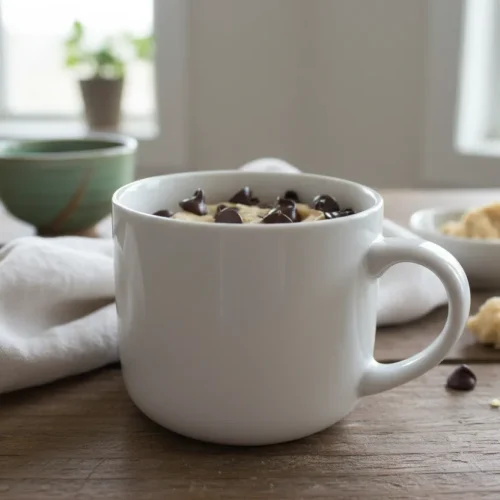
1 Minute Chocolate Chip Mug Cookie
Equipment
- Large microwave-safe mug (wide-bottomed recommended)
- Knife (for leveling flour)
Ingredients
Ingredients for Your No-Egg Cookie Dough Mug Cake
- 40 g unsalted butter
- 1 tablespoon granulated white sugar Non-negotiable part of the 50/50 blend
- 1 tablespoon brown sugar Pack tightly
- 1/4 teaspoon vanilla essence OR 1/8 teaspoon vanilla extract (optional)
- 5 tablespoon plain flour / all-purpose flour
- 1/4 teaspoon baking powder The precise tipping point for lift
- 1 Pinch salt Flavor enhancer
- 2 tablespoon chocolate chips Plus extra for topping
Instructions
The Foolproof 4-Minute Blueprint
- Place the butter in a large microwave-safe mug. Microwave on high for 20 seconds or until the butter is melted. Stir through the sugars and vanilla essence.
- Add the plain flour, baking powder and salt and stir until a soft dough comes together. Stir through the chocolate chips. Flatten down the dough down into the mug then top with extra chocolate chips, if desired.
- Microwave for 1 minute (based on an 1100 watt microwave). Allow to cool for 1 minute before eating. Enjoy!