The optimized edible cookie dough truffle is the result of that investigation, focusing on engineering the perfect texture and cutting your set time in half. My goal was to eliminate the guesswork and the fragility that plagues most no-bake recipes. By deconstructing the interaction between fats, sugars, and stabilizers, I developed a system that ensures a repeatable, high-quality outcome every single time you step into the kitchen. We are looking for a specific mouthfeel that mimics a classic cookie without the graininess often associated with raw sugar and flour.
This blueprint requires a Prep Time of 85 Minutes and a Cook Time of 5 Minutes, resulting in a Total Time of 90 Minutes. Within that window, we handle the safety protocols for the dry ingredients and the aeration of the fats to ensure the final product is both safe and delicious. If you have ever struggled with treats that feel too heavy or ones that lose their shape before you can finish dipping them, this methodical approach is designed specifically for you. We will focus on edible cookie dough truffles no bake as a category of precision, not just a casual snack.
Through my testing, I realized that the primary point of failure in most recipes is a lack of temperature control. Most home cooks treat the cooling process as a passive step, but I view it as a critical phase of structural development. When we optimize the cooling cycle, we are not just saving time; we are ensuring the fats within the dough reach a state of solid suspension that can withstand the thermal energy of melted chocolate. Let us break down exactly how to achieve these results through a series of calculated steps.
Table of Content
Engineering the Base: Mastering the Butter and Sugar Creaming Phase
The foundation of a superior truffle interior lies in the initial interaction between the unsalted butter and the sugars. Most recipes treat creaming as a simple mixing step, but from an engineering perspective, this is where we introduce the aeration necessary for a non-dense texture. When you beat the butter and sugars together, the sharp edges of the sugar crystals cut through the fat, creating millions of tiny air pockets. If you skip this or rush it, the resulting dough will feel heavy and greasy on the palate rather than light and melting.
I have found that the visual cues during this process are more important than a strict timer. You must beat the butter and sugars until the mixture becomes noticeably paler in color, moving from a deep yellow to a pale lemon hue. The texture must also transform, becoming noticeably lighter and fluffy. In my test kitchen, this usually takes a full 2-3 minutes on medium-high speed. If the mixture still looks like wet sand or maintains a dark golden color, the sugar hasn’t been properly integrated into the fat structure, and your final result will suffer.
Pro tip: Ensure your butter is at exactly room temperature, roughly 65 to 68 degrees Fahrenheit, to allow the sugar crystals to properly aerate the fat without melting it.
To help you identify the correct state of your dough base, I have compiled a comparison of the results I observed during my iterative testing.
| State Achieved | Visual/Tactile Cue | Impact on Final Truffle |
|---|---|---|
| Undesirable State | Grainy, dense, yellow color remains | Crumbly, heavy texture after setting |
| Optimized State | Noticeably pale, light, and airy fluff | Perfect, melt-in-your-mouth interior |
Once you achieve the optimized state, you have created a stable matrix that will hold the flour and milk in a balanced suspension. This aeration is critical for texture because it prevents the final product from feeling like a solid block of fudge. Instead, the truffle will have a delicate resistance that gives way easily when bitten. This is the difference between a homemade snack and a professional-grade confection.
Ingredient Integrity: Why We Don’t Substitute the Binder
One of the most frequent questions I receive regarding this process is why I choose milk as a binder instead of the more common sweetened condensed milk. My testing showed that sweetened condensed milk introduces an overwhelming level of sugar and a viscous, sticky texture that interferes with the clean “snap” of the chocolate coating. By using standard milk, we control the moisture content precisely without adding unnecessary sugars that would mask the delicate notes of vanilla and sea salt. This choice is about maintaining the balance of the flavor profile I engineered for this specific recipe.
Beyond flavor, there is the critical matter of safety when dealing with a no-bake product. Many people forget that raw flour is a raw agricultural product that has not been treated to kill pathogens like E. coli or Salmonella. To mitigate this risk, I conducted several tests on heat-treating the flour. I found that spreading the flour on a parchment lined baking sheet and baking it at 350F for 5 minutes is the most effective way to ensure safety without altering the flavor profile of the wheat.
Common Mistake: Skipping the cooling phase after heat-treating the flour. If you add hot flour to your creamed butter, you will melt the air pockets you worked so hard to create, resulting in a flat, oily dough.
The flour must be cooled completely before it ever touches the butter mixture. I usually transfer it to a cold bowl and whisk it a few times to release the trapped heat. This safety measure is non-negotiable for any edible cookie dough truffles no bake project. It ensures that your kitchen remains a place of both excellence and safety. By treating the flour as a potential hazard and neutralizing it, you demonstrate the diligence of a true expert. For another great dessert, try my amazing lemon tart recipe.
The Science of Setting: Why Freezing Beats Refrigeration by 30 Minutes
The most significant efficiency gain in this recipe comes from a shift in how we handle the setting phase. Traditional methods often rely on refrigeration for 60 minutes or more, but my testing shows that a 30-minute freeze is the optimal time for achieving the necessary structural integrity for a clean dip. This is not just about speed; it is about the physics of the dipping process. A frozen center provides a solid foundation that resists the heat of the melted chocolate, preventing the dough from softening or deforming during the coating process.
We will optimize; we will not wait unnecessarily. However, there is a specific technique required when working with frozen centers. I tested dipping the frozen balls immediately versus letting them warm for 5 minutes. When dipping immediately, I found that the coating often cracked upon setting because the rapid temperature change caused the chocolate to contract too quickly. This is known as thermal shock. To prevent this, I allow the melted chocolate to cool slightly before I begin the dipping process.
Pro tip: Use a fork or a dedicated chocolate dipping tool to submerge the dough balls, and tap the tool gently against the side of the bowl to remove excess chocolate for a thin, professional shell.
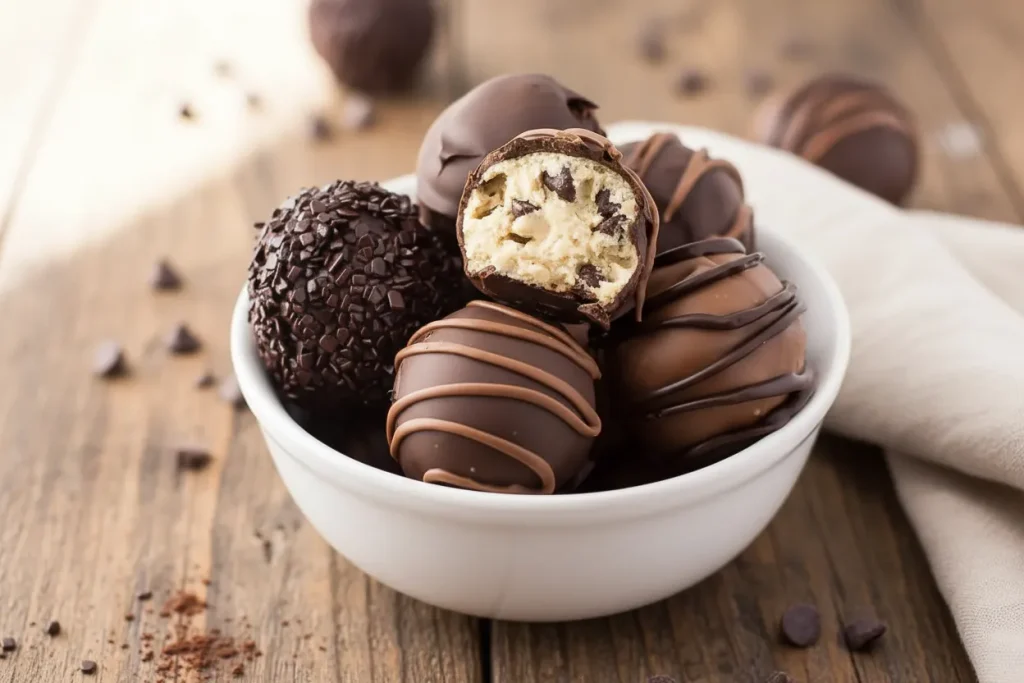
When you use slightly cooled (not warm) melted chocolate on the frozen centers, the coating sets smoothly and stays shiny. This slight cooling time for the chocolate, combined with the 30-minute freeze for the dough, ensures the final aesthetic is flawless. You will hear a satisfying crack when you bite into the finished treat, revealing the soft, perfectly aerated dough inside. This contrast in textures is the hallmark of a well-engineered dessert.
Yield, Storage, and Seasonal Variations
When following this blueprint exactly, you can expect a yield of approximately 36 truffles, depending on the precision of your 2-teaspoon scoop. Consistency in size is not just for aesthetics; it ensures that every piece has the same ratio of chocolate coating to dough center. This balance is vital for the overall sensory experience. If the balls are too large, the dough will overwhelm the chocolate; if they are too small, the chocolate shell will dominate.
- Yield: Approximately 36 truffles using a standard 2-teaspoon cookie scoop.
- Storage: For best quality and texture, these must be kept refrigerated in an airtight container. They firm up nicely when chilled and should be consumed within 7 days for peak freshness.
- Seasonal Variation (Peppermint Twist): For a festive alternative, I have tested using 1/4 tsp peppermint extract in the dough and dipping the centers in white chocolate tinted with a drop of red oil-based coloring.
Managing the storage environment is just as important as the preparation. Because we are using real butter and milk, these treats are sensitive to ambient temperature. If left on a counter in a warm room, the interiors will soften, losing that specific resistance we worked to achieve. I always recommend taking them out of the refrigerator about 5 to 10 minutes before serving to let the chocolate shell lose its chill while the center remains firm.
Pro tip: If you plan to gift these, place them in individual mini cupcake liners within a sturdy box to prevent them from rolling around and scuffing the delicate chocolate finish.
Ingredients
The ingredients listed below are the raw materials for our system. The flour listed below must be heat-treated according to the instructions in the preceding section to mitigate bacterial risk. This is non-negotiable for a safe, no-bake product. Any deviation in measurements can result in a dough that is either too dry to hold its shape or too wet to set properly.
- 1 cup + 2 Tbsp all-purpose flour (heat-treated)
- 1/2 cup unsalted butter (room temperature)
- 1/2 cup light brown sugar (packed)
- 1/4 cup granulated sugar
- 1 tsp vanilla extract
- 1/2 tsp sea salt
- 2/3 cup mini chocolate chips
- 3 Tbsp milk
- 200 g milk chocolate (chopped)
- 200 g dark chocolate (chopped)
Through my testing, I found that using a combination of milk and dark chocolate for the coating provides a more complex flavor profile than using just one type. The dark chocolate offers a needed bitterness that cuts through the sweetness of the dough, while the milk chocolate provides a creamy finish. I prefer chopping blocks of chocolate rather than using chips for the coating, as the higher cocoa butter content in block chocolate results in a much smoother melt and a glossier finish.
Instructions
- Spread flour on a parchment lined baking sheet and bake at 350F for 5 minutes. Cool completely.
- Line a separate baking sheet with parchment.
- In a small bowl, whisk cooled flour and salt, set aside.
- Beat butter until creamy, add sugars and beat on high until pale and fluffy (approx. 2-3mins). Add vanilla and mix until combined.
- Reduce speed to low and slowly add in flour mixture. Mix until just incorporated. Slowly pour in milk. Increase speed to med-high and beat for 2-3 minutes. Stir in chocolate chips.
- Using a small cookie scoop (2 tsp), scoop cookie dough and roll into balls. Place on prepared baking sheet and freeze for 30mins.
- Place chopped chocolate into two separate microwave bowls. Microwave separately, starting with 30 seconds, stir, then in 10 second intervals until chocolate is completely melted. Allow to cool slightly.
- Remove cookie dough balls from freezer and dip into melted chocolate using a fork or chocolate dipping tool. Place on parchment lined baking sheet and drizzle with additional chocolate if desired.
- Refrigerate for 15mins to set.
The reason we beat the dough on high speed after adding the milk in step 5 is to incorporate critical air back into the mixture. When you add the flour, the mixture naturally becomes more dense and heavy. This second aeration phase balances that density, which directly contributes to the superior texture we engineered earlier. You will notice the dough becomes more supple and easier to scoop once this step is completed.
Pro tip: When melting the chocolate in the microwave, never skip the stirring intervals. Chocolate can burn in the center even if the edges look solid; stirring ensures even heat distribution and prevents the fats from separating.
Frequently Asked Questions
How do I make these without baking (No-Bake method)?
While the final product does not require the traditional baking of the assembled treats, the heat-treatment of the flour is a mandatory step that involves a very brief stint in the oven. This is a safety protocol designed to eliminate bacteria. If you absolutely cannot use an oven, you can heat-treat the flour in a microwave by heating it in 30-second intervals and stirring until it reaches 160 degrees Fahrenheit. Once the flour is safe and cooled, the rest of the process is entirely no-bake, relying on the freezer to provide the necessary structure.
What is the role or substitute for sweetened condensed milk in this recipe?
In many inferior recipes, sweetened condensed milk acts as both the sugar source and the liquid binder. However, I have found that it creates a texture that is far too sticky and difficult to manage. In this recipe, we use a combination of granulated and brown sugars for flavor and texture, while standard milk serves as the binder. This allows us to control the moisture levels without adding excessive, cloying sweetness. I do not recommend substituting sweetened condensed milk here as it will completely alter the structural integrity of the dough.
Can I use store-bought (Pillsbury) cookie dough instead of making the dough from scratch?
I strongly advise against using pre-packaged, store-bought cookie dough for this recipe. Most commercial doughs are designed to be baked and contain leavening agents like baking soda or powder that can have a bitter, unpleasant metallic taste when consumed raw. Furthermore, they are often not heat-treated for raw consumption unless specifically labeled as such. Making the dough from scratch using my engineered ratios ensures both a superior flavor and a texture that is optimized for dipping and freezing. For a different take on raw dough, look at my ultimate, proven cookie dough dip recipe.
Are there versions that do not require flour (No Flour)?
There are recipes that use almond flour or heat-treated oat flour as a substitute for all-purpose wheat flour. If you choose to use a flour alternative, be aware that the absorption rates for liquids like milk will change. In my testing, almond flour requires about 20% less milk to achieve a similar consistency. However, for the classic cookie dough flavor and the specific structural stability required for these truffles, heat-treated all-purpose flour remains the gold standard in my kitchen laboratory.
Conclusion: Mastering Your Truffle Production Line
You now have a complete, engineered blueprint for creating a dessert that far exceeds the quality of standard no-bake recipes. By focusing on the aeration of the butter and sugar, and by respecting the safety requirements of heat-treating your flour, you have moved from a casual cook to a practitioner of kitchen precision. The 30-minute freeze is the secret to your efficiency, allowing you to produce a large batch of professional-grade treats in a fraction of the time required by traditional methods.
The contrast between the snap of the cooled chocolate shell and the light, airy interior of the dough is the ultimate reward for your diligence. This recipe removes the points of failure that cause other sweets to crumble or melt, giving you a repeatable system for success. Whether you are preparing these for a gift or as a personal indulgence, the quality of the result will be evident in every bite. The science of the creaming phase and the physics of the setting phase work together to ensure your success.
I challenge you to run your own A/B test between this 30-minute freeze method and any slower refrigeration methods you have used previously. I am confident that the structural integrity and the time savings of this approach will make it your new standard. Please report your findings and texture results in the comments below, as I am always interested in how these systems perform in different home environments. Share this optimized blueprint with any home baker who needs their process refined; let us help everyone engineer something truly delicious.
Common Mistake: Trying to dip the dough balls when they are only partially chilled. If the center is soft, the fork will tear through the dough, leaving crumbs in your melted chocolate and ruining the smooth finish of subsequent truffles. Wait the full 30 minutes in the freezer to ensure a clean, professional production line.
As you become more comfortable with this system, you might find yourself experimenting with different chocolate percentages or minor flavor extracts. Always remember to maintain the balance of fats and liquids to keep the structural integrity intact. With this blueprint in hand, you are no longer just following a recipe; you are managing a precise culinary process designed for excellence. Enjoy the fruits of your engineered labor and the satisfaction of a job well done.
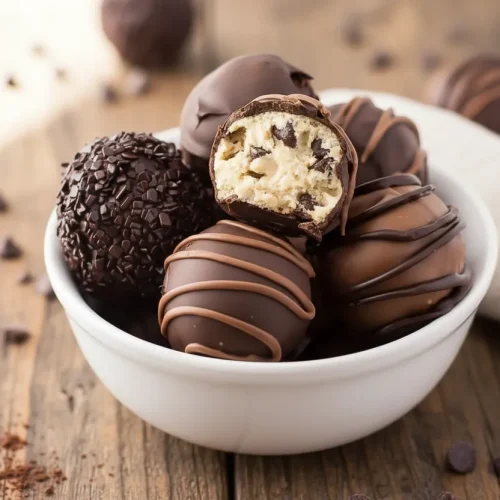
Cookie Dough Truffles
Equipment
- Parchment lined baking sheet
- Small cookie scoop (2 tsp)
- Two separate microwave bowls
- Fork or chocolate dipping tool
Ingredients
Dough Ingredients
- 1 cup all-purpose flour heat-treated
- 2 Tbsp all-purpose flour heat-treated
- 1/2 cup unsalted butter room temperature
- 1/2 cup light brown sugar packed
- 1/4 cup granulated sugar
- 1 tsp vanilla extract
- 1/2 tsp sea salt
- 2/3 cup mini chocolate chips
- 3 Tbsp milk
Chocolate Coating
- 200 g milk chocolate chopped
- 200 g dark chocolate chopped
Instructions
Dough Preparation and Safety
- Spread flour on a parchment lined baking sheet and bake at 350F for 5 minutes. Cool completely.
- Line a separate baking sheet with parchment.
- In a small bowl, whisk cooled flour and salt, set aside.
- Beat butter until creamy, add sugars and beat on high until pale and fluffy (approx. 2-3mins). Add vanilla and mix until combined.
- Reduce speed to low and slowly add in flour mixture. Mix until just incorporated. Slowly pour in milk. Increase speed to med-high and beat for 2-3 minutes. Stir in chocolate chips.
Shaping and Setting the Centers
- Using a small cookie scoop (2 tsp), scoop cookie dough and roll into balls. Place on prepared baking sheet and freeze for 30mins.
Coating the Truffles
- Place chopped chocolate into two separate microwave bowls. Microwave separately, starting with 30 seconds, stir, then in 10 second intervals until chocolate is completely melted. Allow to cool slightly.
- Remove cookie dough balls from freezer and dip into melted chocolate using a fork or chocolate dipping tool. Place on parchment lined baking sheet and drizzle with additional chocolate if desired.
- Refrigerate for 15mins to set.