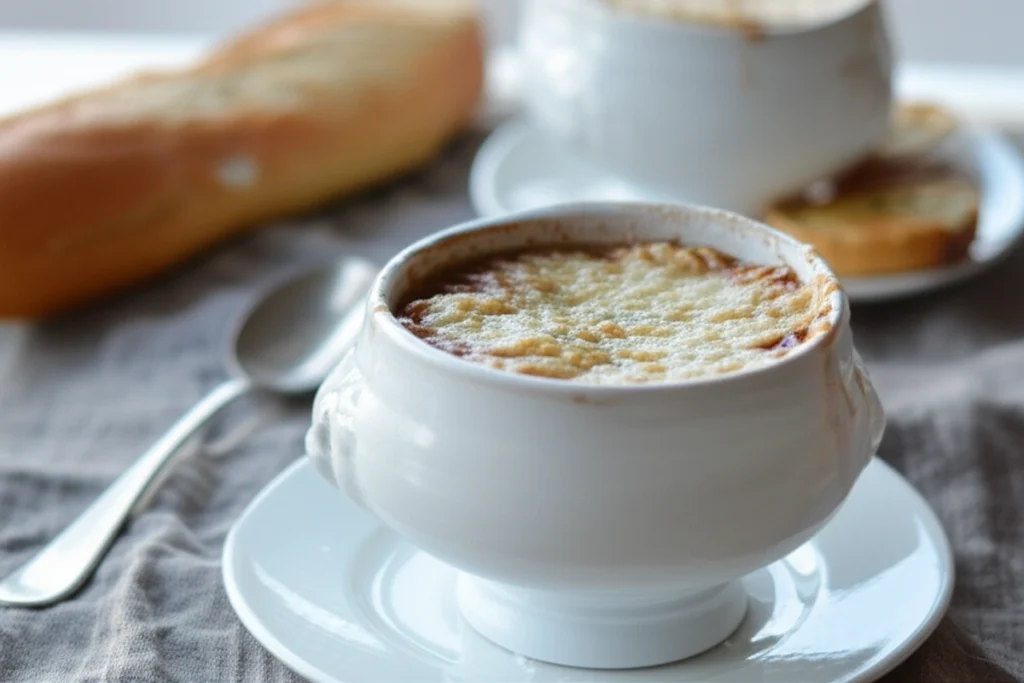
There’s an undeniable allure to classic french onion soup. It’s a dish that promises deep, soul-satisfying flavor in every spoonful. I spent years chasing that perfect bowl, initially falling short with either bland, lifeless onions or ones that were acrid and burnt.
Then came my “aha!” moment: I realized making truly great French onion soup wasn’t just about following a list of ingredients; it was about understanding the science behind the caramelization and building layers of flavor. The most important thing I learned was how controlling the heat and properly stirring the onions can make or break the dish.
This classic French onion soup recipe unlocks the secrets to achieving that restaurant-quality depth right in your own kitchen. Get ready, because with a prep time of just 20 minutes, a cook time of 1 hour and 40 minutes, and a total time of 2 hours, you’re just a few steps away from an exceptional soup.
Table of Content
The Alchemic Caramelization: How to Build Unrivaled Flavor in Classic French Onion Soup (Not Just Browned Onions)
The journey to exceptional French onion soup begins, and largely depends, on one crucial process: caramelization. It’s more than just browning onions; it’s an alchemic transformation that unlocks a symphony of flavors.
This transformation is driven by the Maillard reaction, a complex dance between heat, sugars, and amino acids naturally present in the onions. As these components interact, hundreds of new flavor compounds are born, creating the signature sweet, savory, and umami notes that define truly great caramelized onions. The Maillard reaction is the key to unlocking unrivaled flavor in French onion soup.
I discovered the hard way that even heat distribution is paramount. I learned to use a wooden spoon to continuously stir and scrape the bottom of the pot. This prevents hot spots that can lead to burning while ensuring every piece of onion participates evenly in the Maillard reaction. Failing to do this resulted in some onions being perfectly caramelized, while others were acrid, and burnt; that one batch of soup taught me that patience and persistence are as important as the ingredients themselves.
The “Secret Ingredient”: Why Apple Cider Vinegar is a Game-Changer in French Onion Soup
The richness of deeply caramelized onions can sometimes verge on being one-dimensional, and in my experience, that’s where a seemingly small addition makes a world of difference in this French onion soup recipe. Apple cider vinegar is that “secret ingredient.”
I’ve found that a splash of apple cider vinegar introduces a vital counterpoint: acidity. This tartness cuts through the sweetness of the caramelized onions, preventing the soup from becoming cloying. It also brightens the savory notes of the beef broth, creating a more vibrant and complex flavor profile.
The vinegar also contributes its own subtle sweetness and depth, complementing the existing caramelized notes. I use it to balance the overall flavor of the soup. Don’t skip it; the acidity elevates the entire French onion soup recipe.
The Flour Factor: Mastering the Roux for a Silky-Smooth French Onion Soup
A silky-smooth texture is as crucial to a truly exceptional French onion soup as is its complex flavor, and that’s where the roux comes in. This simple mixture of flour and butter transforms a potentially thin broth into a velvety indulgence.
The key to a successful roux is proper technique, which I learned through several unfortunate, pasty batches. The goal is to cook the flour sufficiently to eliminate any raw, starchy taste. I start by melting the butter, then whisking in the flour until a smooth paste forms. Then, I cook this mixture over medium-low heat, stirring constantly, for about a minute. You’ll know it’s ready when it develops a light, nutty aroma.
Pro tip: Don’t rush this process. Undercooked flour will leave a pasty taste, while burnt flour will impart a bitter flavor. Getting the roux right can elevate even the simplest soup to a level of luxuriousness.
Ingredients
Here’s everything needed to craft this classic French onion soup. I tested this recipe with both yellow and Vidalia onions. While yellow onions work in a pinch, the natural sweetness of Vidalia onions creates a richer, more complex caramelization. That’s why I specifically call for them.
- 4 tablespoons unsalted butter
- 1 tablespoon vegetable oil
- 3 pounds Vidalia (or sweet) onions (about 5 medium), halved lengthwise and thinly sliced
- ¾ teaspoon salt
- ½ teaspoon freshly ground black pepper
- ¾ teaspoon granulated sugar
- 1 cup beef broth
- 1 tbsp apple cider vinegar
- 2 tablespoons all-purpose flour
- 6 cups beef broth
- 1 teaspoon Worcestershire sauce
- ½ teaspoon dried thyme
- 2 bay leaves
- 1 small baguette, cut into ½-in slices
- 1 tablespoon beef broth
- 1 tbsp apple cider vinegar
- 8 ounces Gruyère cheese, grated (about 2 heaping cups; look for one imported from Switzerland)
- ½ cup grated Parmigiano Reggiano
Instructions
Here’s how I bring together all of the elements to build this French onion soup recipe.
- In a large Dutch oven or soup pot, melt the butter over medium heat. Add the oil, onions, salt, pepper, and sugar. Cook, uncovered, stirring occasionally with a wooden spoon, until onions are deep golden brown and caramelized, 45 to 55 minutes. In the beginning, you will only need to stir the onions occasionally. As they start to brown midway through cooking, you will need to stir them frequently, scraping the fond (the brown particles) from the bottom of the pan. If the onions are browning too quickly, reduce the heat slightly or add a few tablespoons of water to deglaze the pan and continue cooking.
The constant stirring and scraping is key here. I’ve found that this action evenly distributes the Maillard reaction. This prevents hot spots that lead to burning while ensuring even caramelization. Building that fond, those browned bits on the bottom, is critical; they’re packed with flavor, aroma, and color that will deeply enrich the soup. Keep in mind that timing may vary based on your pot and stove, but the deep golden color of the onions is the best indicator of doneness.
- Add the beef broth and apple cider vinegar and raise the heat to high. Cook, stirring with a wooden spoon to scrape any fond from the bottom of the pan, until almost all of the liquid has evaporated and the onions are jammy, 8 to 10 minutes.
- Add the flour and cook, stirring constantly, for one minute.
- Add the broth, Worcestershire sauce, thyme, and bay leaves to the pot. Bring to a boil, reduce the heat to a simmer, and cook, covered, for about 30 minutes.
- While the soup simmers, preheat the oven to 400°F and set an oven rack in the middle position. Arrange the baguette slices in a single layer on a baking sheet and bake until the bread is dry, crisp, and golden at edges, about 10 minutes. Set aside.
- When the soup is finished, remove the bay leaves and add the beef broth and apple cider vinegar; taste and adjust seasoning if necessary. If the soup needs a deeper flavor, try a few shakes of Worcestershire sauce. If it’s not quite sweet enough, add ¼ teaspoon sugar.
- Adjust an oven rack 6 inches from the broiler element and heat the broiler. Place the oven-proof crocks on a baking sheet (see note below if you don’t have oven-proof crocks). Fill them with very hot soup, top each with 1 or 2 baguette slices without overlapping, and sprinkle evenly with Gruyère and Parmigiano Reggiano. Broil until the cheese is melted and bubbly around the edges, 3 to 5 minutes. Let the crocks cool for a few minutes before serving.
- Make-Ahead Instructions: The soup can be made and refrigerated up to 3 days ahead (without toasts or cheese), or frozen for up to 3 months. The toasts can be made (without the cheese) and kept sealed at room temperature for up to 3 days.
- Note: If you don’t have oven-proof soup crocks, place the toast slices on a baking sheet, top each with cheese, and broil for about 2 minutes, until the cheese is melted. Divide the hot soup among regular bowls and top each serving with the cheese toasts.
Frequently Asked Questions
What are the key ingredients that define a classic French onion soup?
For me, the essentials begin with quality onions, specifically a sweet variety like Vidalia. I also consider beef broth to be non-negotiable; it builds the rich base. I also never skip the Gruyère cheese, a good baguette, and, of course, the butter to begin the caramelization. These components, when treated with care, come together to create an unforgettable French onion soup recipe.
What is the ‘secret’ to making a truly exceptional French onion soup? (Specifically addressing flavor depth and richness.)
I’ve found that the secret is not one thing, but a trifecta: deeply caramelized onions, a well-developed fond, and a splash of apple cider vinegar. Caramelizing the onions properly releases their natural sugars and creates layers of flavor. The fond, those browned bits at the bottom of the pot, is essential; it adds depth and complexity. The splash of apple cider vinegar balances the sweetness and adds a necessary brightness. It’s the combination of these three elements that elevates a simple soup to something truly special, with incredible flavor depth and richness.
What are common mistakes to avoid when making French onion soup, especially concerning caramelization?
Through my own trials, I can tell you that the biggest mistake is rushing the caramelization process. I know it takes time and patience, but you must resist the urge to crank up the heat. Doing so will only burn the onions and impart a bitter flavor. Another common pitfall is not stirring frequently enough; this can lead to uneven cooking and scorching. I’ve also learned that not scraping the fond from the bottom of the pot is a missed opportunity. That fond is flavor gold, and neglecting it will result in a less complex soup.
Can you provide information about Julia Child’s French onion soup recipe?
Julia Child’s version of French onion soup is a cornerstone of classic French cooking. I’ve often referenced her techniques as I created this recipe. Like me, she emphasized the importance of proper caramelization and a rich beef broth. It’s worth noting that most classic recipes, including hers, utilize similar building blocks; onions, broth, cheese, and bread. I use that foundation to build something unforgettable.
Conclusion
The science of French onion soup isn’t just about ingredients; it’s about technique, understanding the ‘why’ behind each step. If you follow this blueprint, you’ll unlock restaurant-level flavor in your own kitchen. And you’ll have a rich, deeply flavored soup for you and your family.
I encourage you to try this recipe and leave a comment sharing your experiences. I’m also here to answer any questions you may have as you create your own classic French onion soup. Please share this recipe with your friends and family; great soup is meant to be shared.
Yields: 4 to 6 servings. Storage: Refrigerate for up to 3 days or freeze for up to 3 months. Make-Ahead: The soup can be made ahead of time and refrigerated or frozen.
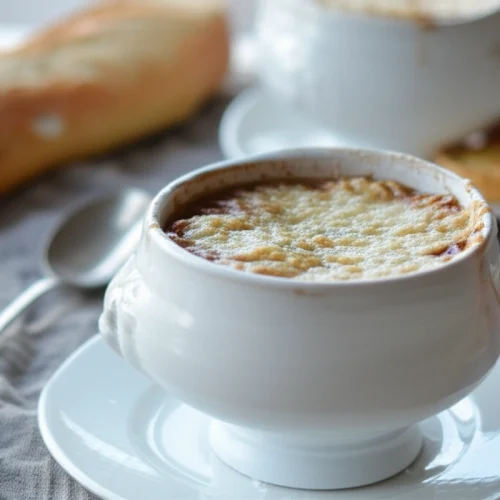
Classic French Onion Soup
Equipment
- Dutch oven
- Soup pot
- wooden spoon
- baking sheet
Ingredients
Ingredients
- 4 tablespoons unsalted butter
- 1 tablespoon vegetable oil
- 3 pounds Vidalia (or sweet) onions about 5 medium, halved lengthwise and thinly sliced
- ¾ teaspoon salt
- ½ teaspoon freshly ground black pepper
- ¾ teaspoon granulated sugar
- 1 cup beef broth
- 1 tbsp apple cider vinegar
- 2 tablespoons all-purpose flour
- 6 cups beef broth
- 1 teaspoon Worcestershire sauce
- ½ teaspoon dried thyme
- 2 bay leaves
- 1 small baguette cut into ½-in slices
- 1 tablespoon beef broth
- 1 tbsp apple cider vinegar
- 8 ounces Gruyère cheese grated (about 2 heaping cups; look for one imported from Switzerland)
- ½ cup grated Parmigiano Reggiano
Instructions
Instructions
- In a large Dutch oven or soup pot, melt the butter over medium heat. Add the oil, onions, salt, pepper, and sugar. Cook, uncovered, stirring occasionally with a wooden spoon, until onions are deep golden brown and caramelized, 45 to 55 minutes. In the beginning, you will only need to stir the onions occasionally. As they start to brown midway through cooking, you will need to stir them frequently, scraping the fond (the brown particles) from the bottom of the pan. If the onions are browning too quickly, reduce the heat slightly or add a few tablespoons of water to deglaze the pan and continue cooking.
- The constant stirring and scraping is key here. I’ve found that this action evenly distributes the Maillard reaction. This prevents hot spots that lead to burning while ensuring even caramelization. Building that fond, those browned bits on the bottom, is critical; they’re packed with flavor, aroma, and color that will deeply enrich the soup. Keep in mind that timing may vary based on your pot and stove, but the deep golden color of the onions is the best indicator of doneness.
- Add the beef broth and apple cider vinegar and raise the heat to high. Cook, stirring with a wooden spoon to scrape any fond from the bottom of the pan, until almost all of the liquid has evaporated and the onions are jammy, 8 to 10 minutes.
- Add the flour and cook, stirring constantly, for one minute.
- Add the broth, Worcestershire sauce, thyme, and bay leaves to the pot. Bring to a boil, reduce the heat to a simmer, and cook, covered, for about 30 minutes.
- While the soup simmers, preheat the oven to 400°F and set an oven rack in the middle position. Arrange the baguette slices in a single layer on a baking sheet and bake until the bread is dry, crisp, and golden at edges, about 10 minutes. Set aside.
- When the soup is finished, remove the bay leaves and add the beef broth and apple cider vinegar; taste and adjust seasoning if necessary. If the soup needs a deeper flavor, try a few shakes of Worcestershire sauce. If it’s not quite sweet enough, add ¼ teaspoon sugar.
- Adjust an oven rack 6 inches from the broiler element and heat the broiler. Place the oven-proof crocks on a baking sheet (see note below if you don’t have oven-proof crocks). Fill them with very hot soup, top each with 1 or 2 baguette slices without overlapping, and sprinkle evenly with Gruyère and Parmigiano Reggiano. Broil until the cheese is melted and bubbly around the edges, 3 to 5 minutes. Let the crocks cool for a few minutes before serving.
- Make-Ahead Instructions: The soup can be made and refrigerated up to 3 days ahead (without toasts or cheese), or frozen for up to 3 months. The toasts can be made (without the cheese) and kept sealed at room temperature for up to 3 days.
- Note: If you don’t have oven-proof soup crocks, place the toast slices on a baking sheet, top each with cheese, and broil for about 2 minutes, until the cheese is melted. Divide the hot soup among regular bowls and top each serving with the cheese toasts.
Notes
Storage: Refrigerate for up to 3 days or freeze for up to 3 months.
Make-Ahead: The soup can be made ahead of time and refrigerated or frozen.