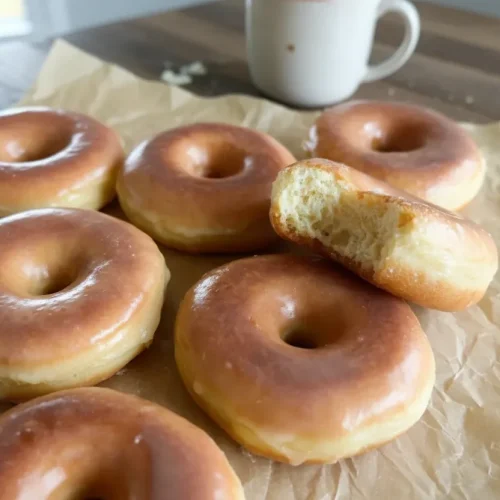
Glazed Sourdough Donuts
This optimized system eliminates the guesswork in sourdough baking by utilizing specific temperature control and a dual bake-then-fry process to achieve light, non-soggy, professional-grade results.
Equipment
- Large Bowl
- Stand Mixer with Dough Hook
- Damp Cloth
- Rolling Pin
- 2 3/4" biscuit cutter
- Chopstick or skewer
- Parchment lined surface
- Deep sided frying pan
- Clip-on thermometer
- Cooling rack lined with paper towels
- Drying rack
Ingredients
Donut Dough Ingredients
- 1 cup 100% hydration sourdough starter (250g)
- 1/2 cup whole milk (115g)
- 1 large egg
- 1/4 cup raw cane sugar (55g)
- 1/4 cup melted unsalted butter (50g)
- 1 tsp vanilla (3g)
- 1 tsp salt (4g)
- 2 1/4 cup organic bread flour (290g)
Maple Smoked Salt Glaze Ingredients (Alternative)
- 1.5 cup powdered sugar
- 0.25 cup pure maple syrup
- 1 teaspoon smoked sea salt
Standard Glaze Ingredients
- 2 cup powdered sugar
- 1/4 cup whole milk
Frying Medium
- 1-3 cups coconut oil for frying
Instructions
Building the Sourdough Donut Dough
- In a large bowl, whisk together the sourdough starter and milk until the starter is fully dissolved and the mixture is uniform in color.
- Add in the egg, sugar, melted butter, and vanilla until everything is well incorporated and the sugar has begun to dissolve.
- Next, sift in your flour and salt and mix until no lumps remain and the dough forms a shaggy, cohesive mass.
- After mixing, cover the dough with a damp cloth and allow it to rest for 30 minutes (autolyse) to ensure full hydration of the flour particles.
- After the rest period, uncover the dough and knead in a stand mixer with a dough hook on medium speed for exactly 12 minutes, or until the dough pulls away from the sides of the bowl and feels like smooth silk.
- Cover the bowl with a damp cloth and allow the dough to rise overnight for 8-10 hours at 70°F(21°C). The dough is ready when it is light, airy, and has doubled in size.
Shaping and Proofing
- Turn the dough out onto a well floured surface. Use a rolling pin to roll the dough into 1/2 inch thickness. If the dough resists being rolled, allow it to relax for 10 minutes and try again.
- Use a 2 3/4" biscuit cutter to cut out the donuts. Gather scraps and allow them to rest for 30 minutes before re-rolling to avoid tough final donuts.
- Take a cut donut and pierce the center with a chopstick or skewer. Spin the dough around the chopstick until the center hole has stretched to a 1" width to ensure it doesn't close up during the rise.
- Place the donuts on a parchment lined surface 2" apart and cover them with a damp cloth. Allow the donuts to rise at room temperature for about 2 hours, or until they have risen by 50% of their original size (they should feel light like a marshmallow).
- Mix the standard glaze together (or maple smoked salt glaze) at the end of the second rise: In a small bowl stir together the milk and powdered sugar until you have a thin runny mixture with no lumps.
Hybrid Cooking Process
- Preheat the oven to 350°F(180°C). Transfer the parchment paper and risen donuts onto a large baking sheet.
- Bake on the center rack for 13-15 minutes until they have just set but have not taken on much color.
- While donuts are baking, heat 1" of coconut oil in a deep sided frying pan over medium heat until it reaches 350°F(180°C). Monitor temperature constantly.
- Add a few pre-baked donuts to the hot oil at a time. Heat for one minute, or just until the bottoms begin to turn golden in color.
- Flip the donuts and heat the other side for one minute or until they begin to turn golden.
- Transfer the cooked donuts to a cooling rack lined with paper towels to soak up any surface oil.
- Allow donuts to cool for a few minutes, then dip one side into the prepared glaze. Place the freshly glazed donuts glaze side up on a drying rack, and allow the glaze to set for 10 minutes before serving.
Notes
The secret to a non-soggy donut is the 30-minute autolyse rest period before kneading. The initial milk temperature must be between 100°F–110°F to optimally activate the wild yeast. If the dough resists rolling, allow it to relax for 10 minutes to ease internal tension. Avoid refrigerating finished donuts, as this causes rapid staling; store at room temperature for up to 24 hours in a ventilated container.
Tried this recipe?Let us know how it was!