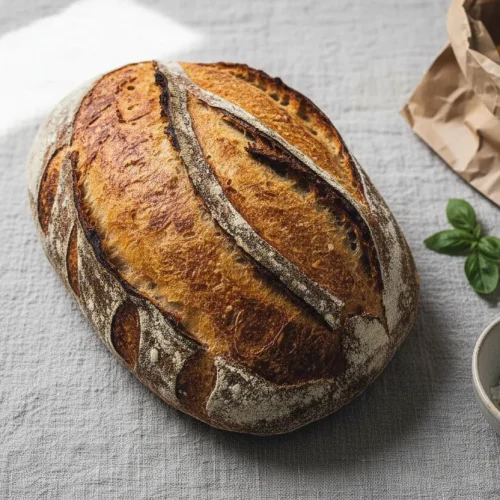
Rustic Rye Sourdough Bread
This expert blueprint transforms the challenge of baking with rye flour by utilizing an optimized flour blend and a crucial delayed salt addition, resulting in a superior loaf structure that eliminates common gummy interiors.
Equipment
- Digital Scale
- Damp Cloth
- Straight-sided container (for measuring bulk ferment)
- Dutch oven
- Banneton (or linen lined banneton)
- Parchment paper
- Serrated Bread Knife
Ingredients
Optimized Flour Blend & Components
- 55 grams active sourdough starter
- 280 grams water slightly warmer than room temperature (about 80-85 degrees F)
- 15 grams honey
- 100 grams rye flour medium (or light)
- 260 grams bread flour high-protein
- 40 grams whole wheat flour
- 7 grams fine sea salt
Instructions
Mixing and Initial Autolyse
- Add starter, water, and honey to a bowl. Whisk thoroughly until combined, using a fork.
- Add flours, and mix together first with the fork to start incorporation, then with your hands until a shaggy dough is formed and the bits of flour just disappear.
- Sprinkle the salt on top and do not mix in; just leave it on top.
- Cover with a damp cloth and let the dough sit undisturbed for one hour (Autolyse phase).
Bulk Fermentation & Folding
- Knead the salt sitting on top into the dough for about 2 1/2 minutes. Think of working the dough through your hands and up against the bowl, push and pull; the dough should start to relax a bit around 1 minute.
- After 30 minutes pass, perform one set of stretch and folds. Repeat 2 more times at 30-minute intervals.
- Let the dough sit, undisturbed and covered with a damp cloth, for the remainder of its bulk fermentation. Finish when the dough has risen about 75% (just short of doubling) in size, is smooth and puffy on top, with a few bubbles around the edges.
Shaping and Final Proof
- When finished with bulk fermentation, lightly dust your work surface with flour. Turn the dough out and pre-shape it. Let it sit for 15 minutes on your work surface.
- Shape your dough to ensure proper tension.
- Place the dough into your flour-dusted banneton (seam side up). You can optionally wait 15 minutes, pinch the perimeters of the dough into the center (stitching), and then proceed to the final rise.
- The final rise can be done on the counter (about 1 1/2 to 2 hours at 70 degrees F) OR do the final rise overnight in the refrigerator, covered in a plastic bag or with a very damp cloth to hold moisture in.
Baking Process
- Preheat your oven to 475 degrees F, with your Dutch oven preheating inside the oven.
- When the oven is preheated, gently flip your dough out onto parchment paper and score your dough (If cold-proofed, score straight from the fridge).
- Put the scored dough into the Dutch oven on the parchment, and put the cover on. Turn oven down to 450 degrees F and slide the Dutch oven in.
- Bake for 20 minutes, then remove the cover.
- Turn heat down to 430 degrees F, and bake for 20 to 25 more minutes, until the crust is golden brown and crackly.
- Remove from the oven, and place the bread onto a cooling rack.
- Wait AT LEAST one hour to cool before slicing to prevent the interior from becoming gummy.
Notes
If you want a German-style variation, add two teaspoons of toasted caraway seeds during the salt incorporation in step 4 of the bulk fermentation. For a more rustic look, roll the shaped dough in rye flakes or additional flour before placing it in the banneton. Always cut into the loaf only after a strict 60-minute cooling period; this allows the starch structure to set properly.
Tried this recipe?Let us know how it was!