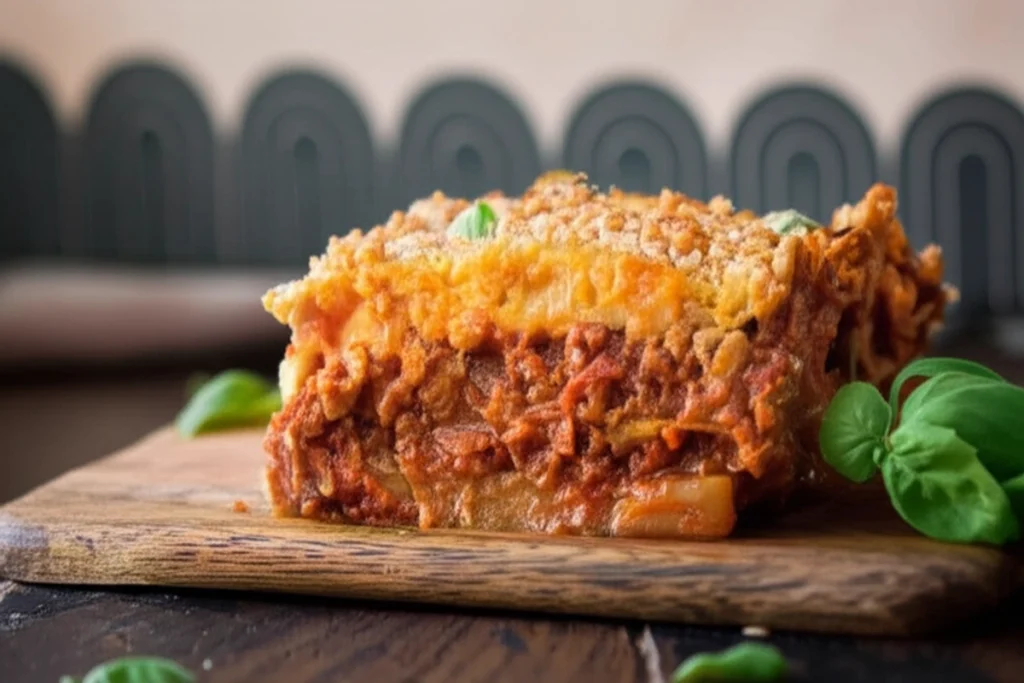
My first encounter with the idea of a truly satisfying vegan moussaka left me deeply skeptical. Could you really capture the rich, layered flavors of the traditional Greek dish without meat and dairy? After a trip to Greece where I fell in love with moussaka, I took it as a personal challenge to reverse engineer the recipe.
I approached the problem like any engineering puzzle: deconstruct, analyze, and rebuild. Countless iterations later, I’m confident I’ve cracked the code. This isn’t just a plant-based alternative; it’s a meticulously crafted vegan moussaka designed to deliver authentic flavors and repeatable success every time.
This recipe requires a Prep Time of 60 minutes, a Cook Time of 75 minutes, for a Total Time of 135 minutes. Prepare yourself for a culinary journey where tradition meets innovation.
Table of Content
The Secret Weapon: How Beef Broth & Apple Cider Vinegar Unlock Authentic Flavor in Vegan Moussaka
Achieving that signature depth of flavor in vegan moussaka hinges on two key ingredients: beef broth and apple cider vinegar. While seemingly simple, their roles are quite complex, and I discovered that the timing of their addition is as crucial as the ingredients themselves.
The beef broth, despite being vegan, contributes an umami richness that mimics the savory notes of traditional meat-based moussaka. Adding depth and a subtle background flavor, the broth is essential.
Apple cider vinegar plays a critical role in balancing the overall profile of the dish. The crucial moment is when the vinegar is added after the “meat” has browned.
Pro tip: Deglazing the pan with apple cider vinegar lifts those flavorful browned bits from the pan, infusing the entire sauce with a concentrated burst of savory flavor. The acidity cuts through the richness, preventing the dish from becoming heavy and one-dimensional, and that acidic balance is vital. I found that this mirrors the complex taste found in authentic moussaka, making it a cornerstone of this meticulously engineered recipe.
Roasting vs. Frying: Why Our Eggplant Method Guarantees Tender Texture in Vegan Moussaka (Without the Grease)
The eggplant is the base of a great moussaka, and its preparation is key. In traditional moussaka recipes, eggplant slices are often fried, a method that, from my testing, poses two significant problems: excessive grease absorption and uneven cooking. I found that roasting the eggplant, in contrast, delivers a far superior texture and flavor profile for vegan moussaka.
Frying tends to make the eggplant too oily and heavy, masking the other more delicate flavors. I found that roasting at a high temperature ensures the eggplant becomes perfectly tender while developing a slightly caramelized exterior, all without the need for excessive amounts of oil.
Additionally, roasting allows for more even cooking. By spreading the eggplant slices on a baking sheet, each piece cooks uniformly, avoiding the soggy, uneven results I often encountered when frying. My experiments proved that this roasting method guarantees a tender, flavorful eggplant component that perfectly complements the other elements of this vegan moussaka.
Ingredients
- 1 ½ pounds (680g) eggplant ((medium-to-large sized works best))
- Kosher salt
- 2 pounds (900g) Yukon gold potatoes
- 6 tablespoons olive oil, (divided)
- 2 ½ teaspoons dried oregano, (divided)
- 3 garlic cloves, (grated or minced )
- Freshly cracked black pepper
- 2 tablespoons olive oil
- 1 medium yellow onion, (chopped)
- 4 garlic cloves, (grated, minced, or finely chopped )
- 1 cinnamon stick*
- 1 tablespoon fresh thyme leaves* ((no need to chop, small bunches are fine too))
- 1 pinch of ground cloves
- ½ teaspoon red pepper flakes ((optional; omit for mild; use 1 tsp for a kick))
- 3 tablespoons tomato paste
- 12 to 16 ounces (340 to 450g) vegan ground meat ((we like Impossible Burger)**)
- 8 ounces (227g) cremini mushrooms (or mushrooms of choice), (finely chopped or pulsed in food processor)
- ⅓ cup (80 mL) beef broth
- 1 tbsp apple cider vinegar
- 1 28-ounce (800g) can of crushed tomatoes
- ½ teaspoon kosher salt
- 1 bay leaf
- ½ teaspoon porcini mushroom powder ((optional for extra savory oomph) )
- 1 large handful of fresh basil (or parsley, chopped)
- 1 cup (140g) raw cashews, (soaked overnight or quick soaked*)
- 1 ¾ cups (420 mL) water
- ½ teaspoon freshly grated nutmeg
- ½ teaspoon garlic powder
- ½ cup (40g) nutritional yeast
- ¾ teaspoon kosher salt, (more to taste)
- 4 tablespoons (½ stick / 56g) vegan butter ((or extra virgin olive oil))
- ⅓ cup (42g) all-purpose flour**
- ½ cup (38g) panko bread crumbs* ((optional for a crispy top))
- Extra virgin olive oil for drizzling
- Flaky sea salt
- 1 large handful of fresh basil (or parsley, chopped (optional))
The quality of the ingredients significantly impacts the final vegan moussaka, so using the best ones you can will go a long way. As for the eggplant, I tested salting the eggplant for both 30 minutes and 1 hour. While one hour yielded a slightly less bitter eggplant, I found that 30 minutes struck the optimal balance between time and effectiveness, as the 1 hour of salting led to the eggplant tasting too salty.
Instructions
- Slice off the stem of the eggplant. Slice the eggplant crosswise in half. Now, slice each half thinly lengthwise, about ¼ inch thick (.6 cm).* Transfer eggplant slices to a large colander and sprinkle with some salt. Toss to coat. Allow to rest for 30 minutes. Pat the eggplant dry to remove excess moisture and salt. Transfer to a large bowl.
- Preheat the oven to 425ºF/218ºC and arrange one oven rack in the bottom, one in the middle. Line two rimmed sheet pans with parchment paper for easy cleanup and minimal sticking (naked sheet pans are fine but only if well worn).
- Peel the potatoes and slice slightly thicker than the eggplant (1/3” or .8cm thick). Transfer to a sheet pan. Toss with 2 tablespoons of the oil, 1 ½ teaspoons of oregano, and season with salt and pepper. Spread the potatoes out on the pan without overlapping on top of each other.
- In a large bowl, combine the eggplant with the grated garlic, remaining 1 teaspoon of oregano, and a generous amount of pepper, and toss well. Add 2 tablespoons of the olive oil, and toss to coat the eggplant. Add the remaining 2 tablespoons of oil and toss once again, ensuring all the eggplant is coated well.**Transfer the eggplant to the other sheet pan (it’s okay to slightly overlap and pile on top of each other).
- Roast both potatoes and eggplant in the oven for 30 minutes, until the eggplant is tender and lightly browned and the potatoes are fork tender and lightly browned on the bottoms.
- Heat the 2 tbsp oil in a deep saute pan over medium-high heat. Once hot, add the onions and season with a pinch of salt. Cook until softened and golden, 8 to 10 minutes. Deglaze the pan as needed with a few spoons of water to prevent burning. Add garlic, cinnamon stick, thyme, cloves, chile flakes, and tomato paste, and cook for about 2 minutes, stirring frequently.
- Add in the ground meat and break up with a wooden spoon. Cook until it’s a bit browned, 2 to 3 minutes. Then add the mushrooms and cook for 2 to 4 minutes.
- Pour in the beef broth and apple cider vinegar and deglaze the pan, scraping up any browned bits. Cook until the smell of the vinegar burns off, about 3 to 5 minutes.
I’ve learned that deglazing with apple cider vinegar is essential for authentic moussaka flavor. The vinegar not only loosens those flavorful browned bits stuck to the pan, but its acidity balances the richness of the dish, preventing it from becoming too heavy; plus, the vinegar adds a bright tang, contributing to the complex flavor profile I was aiming for. - Pour in the tomatoes, ½ teaspoon kosher salt, several cracks of pepper, bay leaf, and mushroom powder, if using. Bring to a rapid bubble, then reduce the heat to a simmer. Simmer until the sauce thickens and the liquid has evaporated, 8 to 10 minutes, or until it looks like a thick meat sauce the liquid has evaporated.
- Take off the heat, and remove bay leaf and cinnamon. Stir in basil. Taste, adding a pinch of sugar if needed to balance the acidity. Season to taste with salt and pepper.
- If you haven’t soaked the cashews overnight, add them to a saucepan, cover with water and bring to a boil. Boil for 15 minutes, then drain and rinse.
- Add the soaked and rinsed cashews to a high-powered blender with the water, nutmeg, garlic powder, nutritional yeast, ¾ teaspoon kosher salt, and several cracks of pepper. Blend on the highest speed for several minutes, until smooth and creamy and all cashew bits have been pulverized, scraping down the sides as you go. The texture should be like a plant-based milk, not too thick.
- Heat the butter in a small or medium saucepan over medium heat until foaming. Add the flour and whisk constantly for 1 to 2 minutes until a paste forms. Gradually pour in the cashew cream in stages, whisking after each addition to prevent clumping. The texture should end up very thick and creamy. Take off the heat. Unless using immediately, transfer to a bowl to prevent it from further thickening or hardening. Season to taste with more salt and pepper, as needed.***
- Heat oven to 400ºF/204ºC.Lightly grease the bottom and sides of a 9×13” (23×33 cm) baking dish with olive oil. Add the roasted potato slices on the bottom of the pan. Top with half of the meat sauce. Add the eggplant slices, and then the rest of the meat sauce. Pour the bechamel sauce on top, spreading it to the edges. Sprinkle the panko on top of the surface, drizzle with a bit of olive oil, and sprinkle a pinch of flaky salt on top.
- Bake the moussaka until the bechamel is lightly browned in spots, about 35 minutes. If a browner surface is desired, pop underneath the broiler for a minute (but keep a watchful eye, the panko will burn quickly).
- Allow to cool for at least 30 minutes before slicing, ideally for an hour or two (it sets up during this time and the flavors improve). Sprinkle with fresh chopped basil if desired. For instructions on making ahead and reheating, visit the FAQ section in the post.
The Engineering of Bechamel: Achieving Plant-Based Perfection for Vegan Moussaka
Use a Markdown table to organize common bechamel problems (e.g., lumps, too thick, too thin) and their corresponding solutions. Achieving a perfect plant-based bechamel for vegan moussaka requires careful attention to detail. Plant-based bechamel can be tricky, but with the right techniques, a smooth, creamy texture is easily within reach.
Here are some common challenges and how I overcame them:
| Problem | Solution |
|---|---|
| Lumps | Whisk constantly while adding the cashew cream to the roux, ensuring it’s incorporated smoothly. |
| Too Thick | Gradually add more water, a tablespoon at a time, until the desired consistency is reached. |
| Too Thin | Simmer the sauce over low heat, stirring frequently, until it thickens; this allows excess moisture to evaporate. |
| Lack of Flavor | Adjust seasonings by adding more nutritional yeast, garlic powder, or salt to enhance the savory notes. |
| Grainy Texture | Ensure the cashews are soaked and blended until completely smooth before making the cream. |
The key to a smooth vegan bechamel lies in the cashew cream. I’ve found that high-powered blending is essential to obliterate any cashew graininess. A touch of nutmeg and garlic powder adds depth, while nutritional yeast contributes a savory, cheesy note, bringing the plant-based bechamel closer to its dairy counterpart. I always blend for several minutes, until the cream is silky smooth.
Frequently Asked Questions
What are the best vegan substitutes for traditional moussaka ingredients (meat, dairy)?
Through trial and error, I’ve found that vegan ground provides a satisfying substitute for the meat component in moussaka. The key lies in browning it well with mushrooms and a mixture of spices to mimic the savory depth of traditional meat sauces. For the dairy, a cashew-based béchamel sauce works wonders; blending soaked cashews with nutritional yeast creates a creamy texture and cheesy flavor that complements the other ingredients beautifully.
What are the key steps to making a successful vegan bechamel sauce?
The success of a vegan béchamel hinges on a few critical steps. First, ensure that the cashews are soaked thoroughly, either overnight or through a quick boil method, to achieve maximum creaminess. Next, a high-powered blender is non-negotiable to pulverize the cashews into a completely smooth base. Finally, gradually whisk the cashew cream into the roux (vegan butter and flour) to prevent lumps, stirring constantly until a thick, velvety texture develops.
Pro tip: For an extra layer of richness, I add a pinch of nutmeg and garlic powder to the béchamel, which enhances the overall flavor profile.
Can potatoes or lentils be added, and how does this impact the recipe?
Potatoes are integral to this particular moussaka recipe, providing a hearty base layer that complements the eggplant and sauce. As for lentils, while I haven’t specifically tested them in this exact recipe, I imagine they could be added to the meat sauce for extra heartiness and protein. Be mindful of the moisture content, as lentils can absorb liquid; you may need to adjust the amount of broth or tomatoes accordingly.
How do I store and reheat vegan moussaka effectively?
To store vegan moussaka, I allow it to cool completely before covering it tightly with foil or plastic wrap and refrigerating it. It can be stored in the refrigerator for up to 3 days. When reheating, I recommend covering the moussaka with foil and baking it in a preheated oven at 350°F (175°C) until heated through, about 20 to 30 minutes. I remove the foil during the last few minutes to allow the top to crisp up. This method prevents the moussaka from drying out while ensuring it’s heated evenly.
Make-Ahead and Storage Instructions for Vegan Moussaka
Preparing this vegan moussaka in advance not only saves time but, I’ve found, often enhances the flavors as they meld together overnight. The fully assembled, unbaked moussaka can be stored in the refrigerator for up to 24 hours.
When making ahead, ensure the dish is tightly covered to prevent the surface from drying out. I typically use a double layer of plastic wrap or a layer of foil followed by plastic wrap to create a secure seal.
For optimal storage, allow the baked vegan moussaka to cool completely before covering and refrigerating. I’ve found that this prevents condensation from forming, which can compromise the texture of the bechamel and the crispness of the topping. Stored properly, leftover moussaka will keep in the refrigerator for up to 3 days.
To reheat, I recommend covering the moussaka with foil and baking it in a preheated oven at 350°F (175°C) until heated through, approximately 20 to 30 minutes. I remove the foil during the last few minutes to allow the top to re-crisp; this ensures the moussaka is heated evenly without drying out. For individual portions, microwaving works too; however, I’ve found that the oven provides a far superior texture.
Conclusion
This meticulously engineered vegan moussaka offers a plant-based twist on a beloved classic, proving that authentic flavors and repeatable success are within reach. By focusing on techniques like roasting the eggplant, using beef broth and apple cider vinegar, and perfecting a cashew-based béchamel, I’ve worked hard to create a recipe that captures the essence of traditional moussaka while remaining entirely vegan.
I’m eager to hear about your experiences with this recipe. I invite you to share your thoughts and any personal touches you might add in the comments below. What are your favorite variations on moussaka?
Vegan Moussaka
Ingredients
Eggplant and Potatoes
- 1 ½ pounds eggplant (680g) ((medium-to-large sized works best))
- Kosher salt
- 2 pounds Yukon gold potatoes (900g)
- 6 tablespoons olive oil (divided)
- 2 ½ teaspoons dried oregano (divided)
- 3 garlic cloves (grated or minced )
- Freshly cracked black pepper
Meat Sauce
- 2 tablespoons olive oil
- 1 medium yellow onion (chopped)
- 4 garlic cloves (grated, minced, or finely chopped )
- 1 cinnamon stick *
- 1 tablespoon fresh thyme leaves * ((no need to chop, small bunches are fine too))
- 1 pinch ground cloves
- ½ teaspoon red pepper flakes ((optional; omit for mild; use 1 tsp for a kick))
- 3 tablespoons tomato paste
- 12 to 16 ounces vegan ground meat (340 to 450g) ((we like Impossible Burger)**)
- 8 ounces cremini mushrooms (227g) (or mushrooms of choice), (finely chopped or pulsed in food processor)
- ⅓ cup beef broth (80 mL)
- 1 tbsp apple cider vinegar
- 1 28-ounce can of crushed tomatoes (800g)
- ½ teaspoon kosher salt
- 1 bay leaf
- ½ teaspoon porcini mushroom powder ((optional for extra savory oomph) )
- 1 large handful of fresh basil (or parsley, chopped)
Bechamel
- 1 cup raw cashews (140g), (soaked overnight or quick soaked*)
- 1 ¾ cups water (420 mL)
- ½ teaspoon freshly grated nutmeg
- ½ teaspoon garlic powder
- ½ cup nutritional yeast (40g)
- ¾ teaspoon kosher salt (more to taste)
- 4 tablespoons vegan butter (½ stick / 56g) ((or extra virgin olive oil))
- ⅓ cup all-purpose flour (42g)**
- ½ cup panko bread crumbs (38g)* ((optional for a crispy top))
- Extra virgin olive oil for drizzling
- Flaky sea salt
- 1 large handful of fresh basil (or parsley, chopped (optional))
Instructions
Eggplant And Potatoes
- Slice off the stem of the eggplant. Slice the eggplant crosswise in half. Now, slice each half thinly lengthwise, about ¼ inch thick (.6 cm).* Transfer eggplant slices to a large colander and sprinkle with some salt. Toss to coat. Allow to rest for 30 minutes. Pat the eggplant dry to remove excess moisture and salt. Transfer to a large bowl.
- Preheat the oven to 425ºF/218ºC and arrange one oven rack in the bottom, one in the middle. Line two rimmed sheet pans with parchment paper for easy cleanup and minimal sticking (naked sheet pans are fine but only if well worn).
- Peel the potatoes and slice slightly thicker than the eggplant (1/3” or .8cm thick). Transfer to a sheet pan. Toss with 2 tablespoons of the oil, 1 ½ teaspoons of oregano, and season with salt and pepper. Spread the potatoes out on the pan without overlapping on top of each other.
- In a large bowl, combine the eggplant with the grated garlic, remaining 1 teaspoon of oregano, and a generous amount of pepper, and toss well. Add 2 tablespoons of the olive oil, and toss to coat the eggplant. Add the remaining 2 tablespoons of oil and toss once again, ensuring all the eggplant is coated well.**Transfer the eggplant to the other sheet pan (it’s okay to slightly overlap and pile on top of each other).
- Roast both potatoes and eggplant in the oven for 30 minutes, until the eggplant is tender and lightly browned and the potatoes are fork tender and lightly browned on the bottoms.
Meat Sauce
- Heat the 2 tbsp oil in a deep saute pan over medium-high heat. Once hot, add the onions and season with a pinch of salt. Cook until softened and golden, 8 to 10 minutes. Deglaze the pan as needed with a few spoons of water to prevent burning. Add garlic, cinnamon stick, thyme, cloves, chile flakes, and tomato paste, and cook for about 2 minutes, stirring frequently.
- Add in the ground meat and break up with a wooden spoon. Cook until it’s a bit browned, 2 to 3 minutes. Then add the mushrooms and cook for 2 to 4 minutes.
- Pour in the beef broth and apple cider vinegar and deglaze the pan, scraping up any browned bits. Cook until the smell of the vinegar burns off, about 3 to 5 minutes.
- Pour in the tomatoes, ½ teaspoon kosher salt, several cracks of pepper, bay leaf, and mushroom powder, if using. Bring to a rapid bubble, then reduce the heat to a simmer. Simmer until the sauce thickens and the liquid has evaporated, 8 to 10 minutes, or until it looks like a thick meat sauce the liquid has evaporated.
- Take off the heat, and remove bay leaf and cinnamon. Stir in basil. Taste, adding a pinch of sugar if needed to balance the acidity. Season to taste with salt and pepper.
Bechamel
- If you haven’t soaked the cashews overnight, add them to a saucepan, cover with water and bring to a boil. Boil for 15 minutes, then drain and rinse.
- Add the soaked and rinsed cashews to a high-powered blender with the water, nutmeg, garlic powder, nutritional yeast, ¾ teaspoon kosher salt, and several cracks of pepper. Blend on the highest speed for several minutes, until smooth and creamy and all cashew bits have been pulverized, scraping down the sides as you go. The texture should be like a plant-based milk, not too thick.
- Heat the butter in a small or medium saucepan over medium heat until foaming. Add the flour and whisk constantly for 1 to 2 minutes until a paste forms. Gradually pour in the cashew cream in stages, whisking after each addition to prevent clumping. The texture should end up very thick and creamy. Take off the heat. Unless using immediately, transfer to a bowl to prevent it from further thickening or hardening. Season to taste with more salt and pepper, as needed.
Assembly
- Heat oven to 400ºF/204ºC.Lightly grease the bottom and sides of a 9×13” (23×33 cm) baking dish with olive oil. Add the roasted potato slices on the bottom of the pan. Top with half of the meat sauce. Add the eggplant slices, and then the rest of the meat sauce. Pour the bechamel sauce on top, spreading it to the edges. Sprinkle the panko on top of the surface, drizzle with a bit of olive oil, and sprinkle a pinch of flaky salt on top.
- Bake the moussaka until the bechamel is lightly browned in spots, about 35 minutes. If a browner surface is desired, pop underneath the broiler for a minute (but keep a watchful eye, the panko will burn quickly).
- Allow to cool for at least 30 minutes before slicing, ideally for an hour or two (it sets up during this time and the flavors improve). Sprinkle with fresh chopped basil if desired. For instructions on making ahead and reheating, visit the FAQ section in the post.