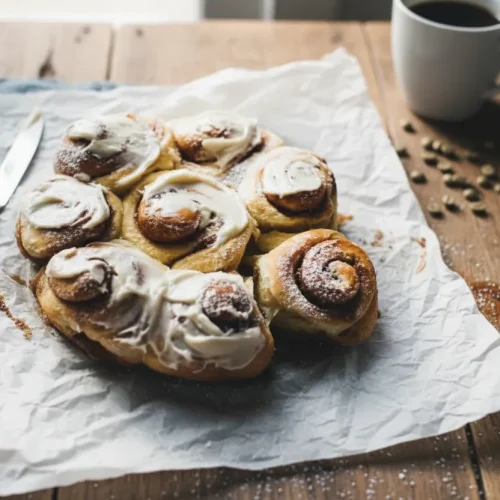
Soft & Gooey Sourdough Cinnamon Rolls
The Optimized Sourdough Cinnamon Roll recipe is a blueprint designed to eliminate guesswork, yielding shatteringly soft rolls with a moist, spiraled interior carrying a distinct but balanced sourdough tang.
Equipment
- Stand mixer with paddle and dough hook attachments
- 9-inch springform pan
- Damp towel
- Plastic wrap
- Rolling Pin
- Offset spatula
- Oiled knife or bench scraper
- wire rack
Ingredients
For the Dough
- 160 g milk, whole or 2%
- 28 g unsalted butter, melted
- 1 large egg
- 100 g bubbly, active sourdough starter
- 24 g granulated sugar
- 300 g King Arthur all-purpose flour
- 5 g fine sea salt
- To coat Cooking spray or oil for coating
For the Filling Paste
- 84 g unsalted butter softened
- 100 g granulated sugar
- 3 tsp ground cinnamon
- 1 level tbsp flour
For the Cream Cheese Glaze
- 2 tbsp unsalted butter softened
- 1/3 cup whipped cream cheese room temperature
- 1/4 to 1/2 cup powdered sugar sifted
- 1 to 2 tbsp milk
Instructions
Mixing and Autolyse
- In the evening, combine 28 grams of melted butter and 160 grams of milk in a small bowl. Allow this mixture to cool until it is just lukewarm to the touch before proceeding.
- Add the large egg, 100 grams of active sourdough starter, and 24 grams of sugar to the bowl of a stand mixer fitted with the paddle attachment. Mix on low until the starter is broken up and combined with the egg.
- With the machine running on low, slowly pour in the cooled milk and butter mixture. Add 300 grams of flour and 5 grams of salt. Continue mixing for about 1 minute until a rough, sticky dough forms and no dry flour remains.
- Scrape down the sides of the bowl to ensure all ingredients are incorporated. Cover the bowl with a damp towel and let the dough rest for 30 minutes to allow the flour to hydrate (autolyse).
Kneading and Bulk Fermentation
- After the rest, switch to the dough hook attachment. Knead the dough on medium-low speed (setting 2 or 3) for 6 to 8 minutes. Watch for the dough to become soft and supple and completely pull away from the sides of the bowl, which indicates the gluten has developed sufficient strength.
- Transfer the dough to a medium-size bowl that has been lightly coated in butter or cooking spray. Cover the bowl tightly with plastic wrap to prevent a skin from forming.
- Optional step: About 30 to 60 minutes into the rise, perform a series of four stretch and folds. Reach under one side of the dough, pull it up high, and fold it over the center. Rotate the bowl and repeat three more times. This step increases the final volume and fluffiness of the rolls.
- Let the dough rise overnight at a temperature of 67 to 68 degrees Fahrenheit for 8 to 12 hours until it has doubled in size.
Shaping and Proofing
- In the morning, line a 9-inch springform pan with parchment paper. Scrunch the paper into a ball first to make it easier to fit into the corners of the pan.
- Lightly oil and flour your countertop. Gently coax the dough out of the bowl and pat it into a rough rectangle. Let it rest for 10 minutes to relax the gluten, which makes the rolling process much easier.
- Dust the dough and your rolling pin with flour. Roll the dough into a 16 by 12 inch rectangle, using a tape measure to ensure you have reached the correct dimensions for even rolls.
- In a small bowl, mix 84 grams of softened butter with 100 grams of sugar, 3 teaspoons of cinnamon, and 1 level tablespoon of flour to create a thick paste. Spread this mixture evenly over the dough using an offset spatula, leaving a 1/2-inch border at the edges.
- Starting from the 16-inch long side, roll the dough into a tight log. Take your time to ensure the log is firm so the spirals do not unravel during the second rise.
- Cut the log into 2-inch sections using an oiled knife or a bench scraper. Mark the top of the log first to ensure you get 9 to 12 equal pieces.
- Place the rolls into the prepared pan. Cover and let them rest for 1 to 2 hours at room temperature until they appear puffed and are touching each other.
Baking and Finishing
- Preheat your oven to 350 degrees Fahrenheit. Place the pan on the center rack and bake for 35 to 40 minutes, checking them at the 30-minute mark. The tops should be a light golden brown when finished.
- Remove the rolls from the oven and let them cool in the pan for 15 minutes. This cooling period is vital because it helps the melted butter and juices from the filling absorb back into the dough.
- While the rolls cool, prepare the glaze by beating the softened butter, whipped cream cheese, and sifted powdered sugar until smooth. Add milk one tablespoon at a time until you reach your desired consistency.
- Lift the rolls out of the pan using the parchment paper and transfer them to a wire rack. Apply the glaze while the rolls are still slightly warm so it can seep into the spirals.
Notes
Success hinges on respecting the long fermentation time required by wild yeast. If your kitchen is warmer than 68°F, the rise time will be shorter, but you sacrifice flavor depth. For a richer dough, you can increase the butter to 115 grams and the flour to 360 grams, but this may require an additional hour of rise time. For fall baking, substitute 1/4 teaspoon of freshly grated nutmeg into the cinnamon filling. For longer storage (over 24 hours), refrigerate, but always reheat briefly to restore the soft texture.
Nutrition
Calories: 450kcalCarbohydrates: 60gProtein: 7gFat: 21g
Tried this recipe?Let us know how it was!