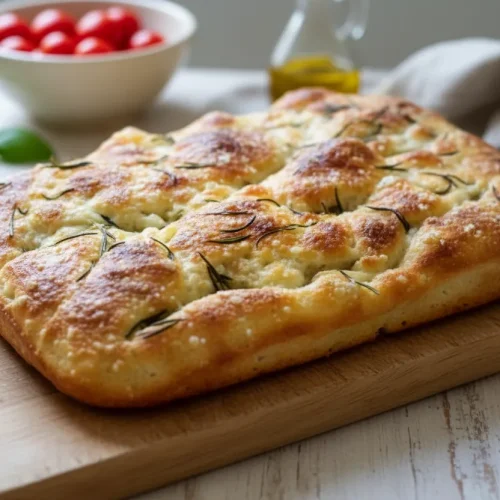
The Engineer’s Focaccia
This recipe represents the optimization of a cold proof process, requiring meticulous control over time and temperature to achieve massive, translucent air bubbles and a shatteringly crisp crust.
Equipment
- Large mixing bowl
- rubber spatula
- Two 8- or 9-inch pie plates OR one 9x13-inch pan
- Two forks
- cooling rack
Ingredients
Main Dough Ingredients
- 512 g all-purpose flour or bread flour see notes above
- 10 g kosher salt minimum, up to 15g maximum
- 8 g instant yeast see notes above if using active dry
- 455 g lukewarm water made by combining 1/2 cup boiling water with 1 1/2 cups cold water
Greasing and Topping
- butter for greasing
- 4 tbsp olive oil divided
- flaky sea salt such as Maldon
- 1 tsp whole rosemary leaves optional, up to 2 tsp
Instructions
Initial Mix and Rest
- In a large bowl, whisk together the flour, salt, and instant yeast. Add the water.
- Using a rubber spatula, mix until the liquid is absorbed and the ingredients form a sticky dough ball.
- Cover the bowl, and let rest for 30 minutes.
Stretch and Fold Development
- Fill a small bowl with water. Using a wet hand, grab an edge of the dough and pull it up and towards the center.
- Repeat this stretching and folding process, 8 to 10 times, moving your hand around the edge of the dough with every set of stretches and folds.
- Continue until the dough transforms from sticky and shaggy to smooth and cohesive.
Cold Proofing
- Rub the surface of the dough lightly with olive oil.
- Cover the bowl with a lid or plastic wrap and place in the refrigerator immediately for at least 12 hours or for as long as three days.
Pan Preparation and Room Temperature Rise
- Line two 8- or 9-inch pie plates or a 9x13-inch pan with parchment paper or grease with butter or coat with nonstick cooking spray.
- Pour a tablespoon of oil into the center of each pan (or 2 tablespoons if using the 9x13-inch pan).
- Using two forks, deflate the dough by releasing it from the sides of the bowl and pulling it toward the center. Rotate the bowl in quarter turns as you deflate, turning the mass into a rough ball.
- Use the forks to split the dough into two equal pieces (or do not split if using the 9x13-inch pan). Place one piece into one of the prepared pans.
- Roll the dough ball in the oil to coat it all over, forming a rough ball. Repeat with the remaining piece.
- Let the dough balls rest, uncovered, for 3 to 4 hours depending on the temperature of your kitchen.
Final Dimpling and Baking
- Set a rack in the middle of the oven and preheat it to 425°F.
- If using the rosemary, sprinkle it over the dough.
- Pour a tablespoon of oil over each round of dough (or two tablespoons if using a 9x13-inch pan).
- Rub your hands lightly in the oil to coat, then, using all of your fingers, press straight down to create deep dimples, pressing all the way to the bottom of the pan.
- If necessary, gently stretch the dough as you dimple to allow the dough to fill the pan. Sprinkle with flaky sea salt all over.
- Transfer the pans or pan to the oven and bake for 25 to 30 minutes, until the underside is golden and crisp.
- Remove the pans or pan from the oven and transfer the focaccia to a cooling rack. Let it cool for 10 minutes before cutting and serving.
Notes
The primary 'secrets' are the long cold proof (12+ hours), the disciplined stretch and fold method (8-10 sets), and a generous application of olive oil. The cold proof develops flavor and browning potential via amylase activity, while the folds build the structural integrity needed to hold large air bubbles. For glass bakeware, using a layer of butter underneath the olive oil in the pan is non-negotiable to guarantee release and prevent sticking. If skipping the cold proof, allow 3 to 4 hours at room temperature, but expect less complex flavor and color.
Tried this recipe?Let us know how it was!