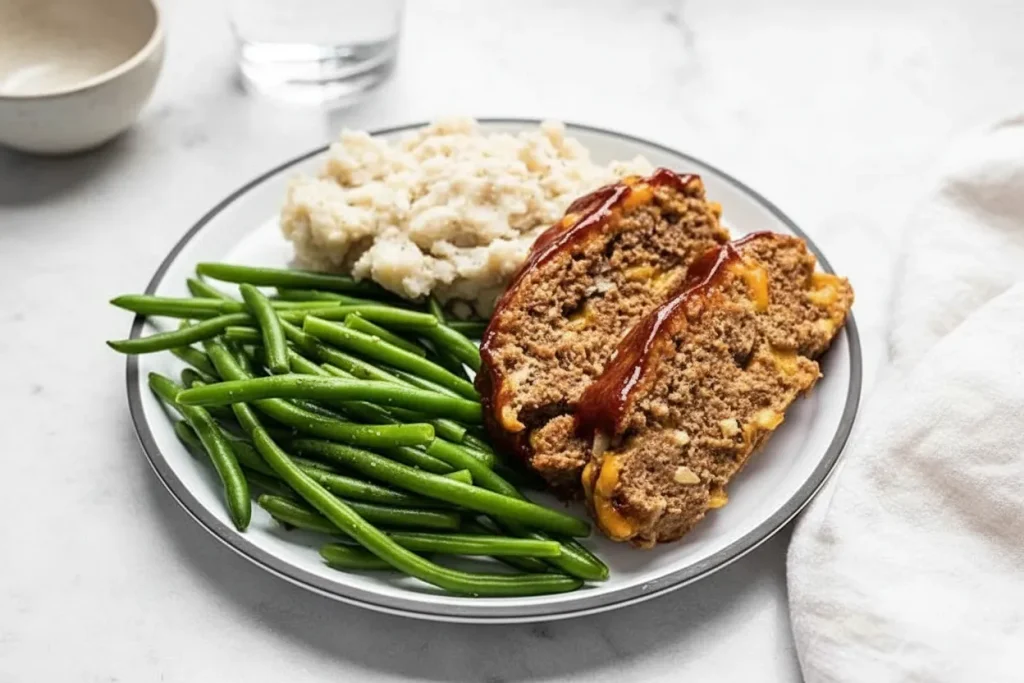
The first time I attempted a cheeseburger meatloaf, I committed a fundamental engineering error. I assumed that more cheese always equaled a better result. I used two cups of finely shredded cheddar, thinking it would create a gooey, uniform interior. Instead, I pulled a disaster out of the oven. The cheese had completely melted into the meat fibers, releasing a river of orange oil that pooled at the bottom of the pan and turned the loaf into a dense, greasy mess. The flavor of the cheese had essentially vanished, replaced by a heavy, oily texture that lacked any structural integrity.
That failure led me to deconstruct the entire dish, treating it like a structural system where every ingredient serves a specific mechanical purpose. I realized that the secret to a successful meatloaf cheese application isn’t about the quantity of the dairy, but the geometry of how it is integrated. I spent several weeks testing different ratios, beef blends, and cheese shapes to solve the problem of disappearing flavor and oily residue. The result is this optimized blueprint that delivers distinct, molten pockets of sharp cheddar encased in a perfectly seasoned, juicy beef matrix.
This process taught me that the prep time of 15 minutes is the most critical window for success. If you rush the chopping or the mixing, the final 50-minute bake will never yield the result you want. The total time of 65 minutes is a small investment for a result that consistently outperforms standard recipes. By treating the kitchen like a laboratory, I have eliminated the guesswork and created a system that works every single time. My approach focuses on creating internal contrast: the snap of the meat, the softness of the onion, and the sudden burst of creamy, melted cheese.
Table of Content
Why We Chop the Cheese: The Critical Difference Between Pockets of Melt and Disappearing Flavor
One of the most frequent questions I receive is about the best type of cheese for this application. After comparing several varieties, including mild cheddar, monterey jack, and colby, I determined that sharp cheddar is the undisputed champion. Its lower moisture content and high flavor profile allow it to stand up to the robust seasonings and the fat content of the beef. However, the form of that cheese is what truly determines the quality of the final slice.
In my testing, I found that shredded cheese is the primary enemy of a good meatloaf. When you shred cheese, you increase its surface area significantly. As the internal temperature of the meat rises, those tiny shreds melt instantly and bond with the proteins in the meat. This prevents the beef from forming a cohesive loaf and causes the fat from the cheese to leach out into the pan. By switching to chopped cheese, specifically pieces the size of a small bean, you create a thermal barrier. The outside of the cheese cube softens, but the core remains intact longer, eventually turning into a distinct pocket of molten flavor that stays exactly where you put it.
| Method | Resulting Texture | Structural Integrity | Flavor Impact |
|---|---|---|---|
| Shredded | Oily and spongy | Low; tends to crumble | Diffused and weak |
| Chopped (Our Method) | Juicy with molten pockets | High; maintains shape | Intense bursts of sharp cheddar |
| Stuffed Center | Dry exterior, lava center | Medium; prone to splitting | Concentrated in one spot only |
| Rolled/Jelly Roll | Gaping holes in the meat | Very Low; seams often leak | Uneven distribution |
I also tested the common technique of rolling the meat around a central core of cheese. This method, while visually striking in some photos, is a disaster from an engineering standpoint. During the bake, the meat expands and contracts. The seams of a rolled loaf are natural points of failure. In three separate trials, the seams split open at the 35-minute mark, allowing the cheese to drain out onto the baking sheet. This left a hollow, dry tunnel in the middle of the meat. Our studded mixing method avoids this by distributing the cheese uniformly, ensuring every bite is identical. For other savory ground meat applications, consider this easy beef ragu recipe for another great savory centerpiece.
Pro tip: Chop your cheese while it is still very cold from the refrigerator to get those clean, bean-sized cubes without them sticking to your knife.
The Mixing Matrix: Why Overworking Your Loaf Guarantees a Dry Result
When constructing the interior of this loaf, I had to consider the relationship between the meat and the binders. A common point of confusion is whether cheese can be added with bread crumbs or if it needs to be mixed in later. My testing confirms that the cheese should be added at the same time as the other components, but the technique used for that integration is where most home cooks fail.
The goal is to maintain a light, airy protein matrix. If you look at meat under a microscope, it is made of long fibers. When you mix ground beef aggressively, those fibers begin to tangle and knit together. This process, known as protein cross-linking, creates a rubbery, bouncy texture similar to a low-quality hot dog. To prevent this, I use a light hand. I mix only until the white flecks of the cheese and the pale wheat color of the breadcrumbs are evenly distributed. This ensures a tender, sliceable loaf that holds its juice rather than squeezing it out like a sponge.
The choice of binder also plays a massive role in the final density. I have experimented with various fillers, including crushed crackers and rolled oats. While oats are a popular choice in some circles, I found they absorb too much moisture from the meat, resulting in a loaf that feels heavy and overly compact. Plain breadcrumbs, as specified in this recipe, act as tiny sponges that trap the fat and moisture released by the beef and the cheese. This creates a soft, luxurious mouthfeel that provides the perfect backdrop for the sharp cheddar pockets.
Pro tip: Use your fingers like a rake rather than a fist when mixing the meat to keep the texture light and prevent over-compaction.
Stop the Grease Slick: How Our 4oz Ratio Prevents Over-Cheesing
A major flaw in many cheeseburger-inspired recipes is the tendency to overload the meat with fat. If you use a high-fat beef blend and a massive amount of cheese, you end up with a grease slick that washes away the delicate flavors of the smoked paprika and Worcestershire sauce. Through a series of weight-based tests, I identified that 4 oz. of cheese per pound of meat is the optimal ratio for this system.
This 4 oz. measurement serves as a flavor accent rather than a primary binder. It provides enough cheese to ensure two or three molten pockets per slice without compromising the structural integrity of the beef. Speaking of beef, the choice of grind is paramount. I tested 80/20, 85/15, and 90/10 blends. The 90/10 was far too dry, while the 80/20 produced so much rendered fat that the glaze couldn’t properly adhere to the surface. The 85/15 blend is the Goldilocks of meatloaf; it has enough fat to remain juicy during a 55-minute bake but not so much that it creates a swimming pool of oil in your casserole dish.
The synergy between the 85/15 beef and the 4 oz. of sharp cheddar is what makes this recipe work. As the loaf bakes, the small amount of rendered fat from the beef helps to gently fry the minced onions inside the loaf, softening their bite and releasing their natural sugars. If there were more cheese, that process would be hindered by excess oil. By keeping the cheese to a precise 4 oz., we allow the other essential traditional ingredients to shine, creating a balanced flavor profile that tastes like a high-end steakhouse burger.
Pro tip: If you see a small amount of fat pooling around the edges of your loaf during the final 10 minutes of baking, don’t worry; this is normal and will be reabsorbed during the resting phase.
The Blueprint: Ingredients for Structural Integrity
This ingredient list is the result of careful calibration. Each component has been selected for its ability to contribute to either the flavor profile or the mechanical stability of the loaf. I tested this exact recipe using various shaping methods, and I found that a simple 7-inch by 4-inch rectangle provides the best surface-area-to-volume ratio for even cooking.
- 1/4 cup plain breadcrumbs: These provide the necessary structure and moisture retention.
- 1 tsp smoked paprika: Adds a deep, earthy color and a hint of backyard grill flavor.
- 1/2 tsp garlic powder: Provides a consistent savory base without the moisture of fresh garlic.
- 3/4 tsp salt: Essential for protein extraction and flavor enhancement.
- 1 large egg: The primary protein binder that holds the matrix together.
- 1/2 cup onion: Must be finely minced to ensure it softens completely during the bake.
- 4 oz. sharp cheddar cheese: Roughly chopped into bean-sized pieces for optimal melting. (I tested this using a jelly-roll method, but the seams split, proving that mixing the cubes directly into the meat is superior).
- 1 lb. ground beef: Use an 85/15 blend for the perfect balance of juice and structure.
- 1/2 cup ketchup: The base of our high-contrast glaze.
- 1 Tbsp brown sugar: Adds the necessary sweetness to balance the vinegar in the mustard.
- 1 tsp yellow mustard: Provides tang and acts as an emulsifier for the glaze.
- 1 tsp Worcestershire sauce: Delivers a concentrated hit of umami to the meat and the glaze.
Every ingredient here serves a purpose. The Worcestershire sauce, for example, contains anchovies and vinegar, which work together to break down some of the tougher proteins in the beef, making the final loaf significantly more tender. When these items are combined in these specific ratios, they create a dish that is far greater than the sum of its parts.
Execution: Step-by-Step Assembly and Glazing
The assembly of the loaf is where the engineering principles of distribution and heat transfer come into play. Follow these steps precisely to ensure your meatloaf has the correct internal texture and a perfectly set glaze.
- Preheat the oven to 350ºF. In a small bowl stir together the breadcrumbs, smoked paprika, garlic powder, and salt. In a separate small bowl, lightly whisk the egg. This ensures that the dry seasonings are evenly distributed before they hit the wet meat.
- Finely mince the onion. Roughly chop the cheddar cheese so that it is in pieces about the same size as a small bean. Uniformity in your chopping leads to uniformity in your melting.
- Add the ground beef, seasoned breadcrumbs, whisked egg, minced onion, and chopped cheddar to a bowl. Use your hands to mix the ingredients together until just incorporated. As we discussed, do not overwork the meat. You want to see distinct pieces of cheese and onion scattered throughout the beef, not a homogenous paste.
- Place the meat mixture in a casserole dish or on a rimmed baking sheet and shape into a rectangle, approximately 7 inches long, 4 inches wide, and 1.5 inches thick. This specific thickness allows the heat to penetrate the center of the loaf at the same rate the glaze sets on the outside.
- To make the glaze, stir together the ketchup, brown sugar, mustard, and Worcestershire sauce. Spread the glaze over the unbaked meatloaf using the back of a spoon to ensure even coverage all the way to the edges.
- Bake the meatloaf in the preheated oven for 50-55 minutes, or until the internal temperature reaches 160ºF. Remove the meatloaf from the oven, let it sit for 5-10 minutes, then slice into eight pieces and serve.
Pro tip: Resting the meat is not optional. During these 10 minutes, the muscle fibers relax and reabsorb the juices. If you cut it immediately, those juices—and the melted cheese—will run out onto the board.
Yield, Storage, and Seasonal Adjustments
This recipe is engineered to yield eight consistent slices, which is ideal for a family of four or for a couple looking for high-quality leftovers. Unlike larger recipes that can take nearly ninety minutes to cook through, this 1 lb. loaf is optimized for a faster turnaround without sacrificing the internal temperature gradients.
When it comes to storage, this meatloaf is remarkably resilient. I have found that wrapping the cooled loaf tightly in plastic wrap or placing it in an airtight container allows it to stay fresh in the refrigerator for up to four days. In fact, the flavor often improves after twenty-four hours as the aromatics from the onion and garlic continue to permeate the beef. For long-term storage, you can freeze individual slices for up to three months. To reheat, I recommend using a low-temperature oven or a skillet to maintain the integrity of the cheese pockets, as a microwave can sometimes cause the cheese to separate.
| Reheating Method | Quality Retained | Time Required | Best For |
|---|---|---|---|
| Skillet (Medium-Low) | Excellent (Crispy edges) | 6 minutes | Maintaining texture |
| Oven (300ºF) | High (Even heating) | 15 minutes | Large portions |
| Microwave | Medium (Can get rubbery) | 2 minutes | Speed |
For a seasonal adjustment, I suggest modifying the glaze during the colder winter months. By adding an extra half-teaspoon of smoked paprika to the ketchup mixture, you can create a much smokier, bolder profile that provides a comforting, fire-roasted sensation. In the summer, you might reduce the brown sugar slightly and add a teaspoon of apple cider vinegar to the glaze for a brighter, more acidic finish that cuts through the richness of the cheese.
Pro tip: When reheating a slice in a skillet, add a teaspoon of water to the pan and cover it with a lid to create steam, which helps melt the cheese pockets without drying out the beef.
Frequently Asked Questions on Meatloaf Cheese Success
What is the best technique for preventing cheese from leaking?
The most effective way to keep your cheese inside the loaf is to use our studded mixing method. By distributing small, bean-sized cubes of cheese throughout the meat matrix, the proteins in the beef can wrap around the cheese as they cook, creating a natural seal. This is far more effective than stuffing the cheese in the center or rolling the meat, both of which create large internal cavities and structural seams that are prone to bursting under the pressure of steam and melting fat.
Can I use pre-shredded cheese?
I strongly advise against using pre-shredded cheese for this recipe. Most bags of shredded cheese are coated with anti-caking agents like potato starch or cellulose. These powders are designed to keep the shreds from sticking together in the bag, but they also prevent the cheese from melting into a smooth, creamy consistency. In my tests, pre-shredded cheese often resulted in a grainy texture and failed to form the distinct molten pockets that are the hallmark of this optimized meatloaf.
What internal temperature guarantees safety and juiciness?
A final internal temperature of 160ºF is the critical target for ground beef. At this temperature, harmful bacteria are eliminated, but the meat has not yet begun to shed its moisture aggressively. If you pull the loaf at 155ºF, carry-over cooking will usually bring it up to the 160ºF mark during the ten-minute resting period. Using a digital meat thermometer is the only way to ensure this level of precision, as visual cues like the color of the juice can be misleading.
Conclusion: The Optimized Cheeseburger Meatloaf Blueprint
Engineering the perfect meatloaf is a study in balance. You need enough fat for flavor, enough binder for structure, and the right cheese geometry for that perfect mouthfeel. By moving away from the standard shredded cheese approach and adopting my chopped cheddar method, you elevate a humble weeknight dinner into a masterclass in textural contrast. The pockets of molten cheese, the savory umami of the Worcestershire, and the sweet-tangy glaze work in harmony because they were designed to do so.
This recipe is more than just a list of ingredients; it is a system built on testing and failure. I have made the oily, crumbly loaves so that you don’t have to. When you pull your loaf from the oven and see that deep amber glaze crackling slightly over the juicy beef, you will know the engineering was worth it. The true test comes with the first slice. If you see those distinct, glistening pockets of gold tucked inside the meat, you have succeeded.
I encourage you to try this studded technique and see the difference for yourself. Does the chopped cheddar change the way you think about meatloaf? I would love to hear about your results and see the photos of your perfectly pocketed slices. Share your experience in the comments below and let me know how the 85/15 blend worked in your kitchen. Let’s keep engineering better meals together, one slice at a time.
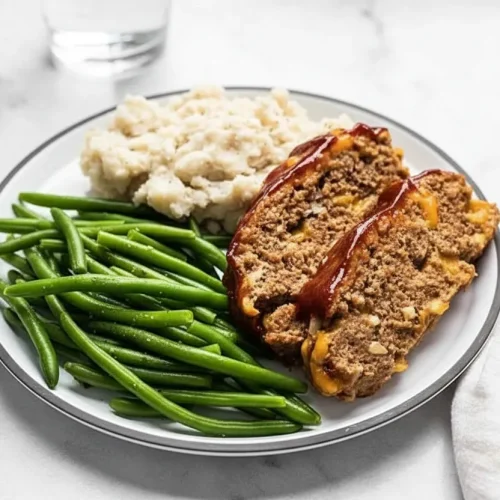
Cheeseburger Meatloaf
Equipment
- Small bowl (for dry ingredients)
- Small bowl (for whisked egg)
- Casserole dish or rimmed baking sheet
- mixing bowl
- Digital meat thermometer
Ingredients
For Structural Integrity & Flavor
- 1/4 cup plain breadcrumbs Provide necessary structure and moisture retention.
- 1 tsp smoked paprika Adds a deep, earthy color and grill flavor.
- 1/2 tsp garlic powder Provides a consistent savory base.
- 3/4 tsp salt Essential for protein extraction and flavor.
- 1 large egg The primary protein binder.
- 1/2 cup onion Must be finely minced to ensure it softens completely.
- 4 oz sharp cheddar cheese Roughly chopped into bean-sized pieces.
- 1 lb ground beef Use an 85/15 blend for the perfect balance of juice and structure.
For the High-Contrast Glaze
- 1/2 cup ketchup The base of the glaze.
- 1 Tbsp brown sugar Adds necessary sweetness.
- 1 tsp yellow mustard Provides tang and acts as an emulsifier.
- 1 tsp Worcestershire sauce Delivers a concentrated hit of umami.
Instructions
Assembly and Baking
- Preheat the oven to 350ºF. In a small bowl stir together the breadcrumbs, smoked paprika, garlic powder, and salt.
- In a separate small bowl, lightly whisk the egg. This ensures that the dry seasonings are evenly distributed before they hit the wet meat.
- Finely mince the onion. Roughly chop the cheddar cheese so that it is in pieces about the same size as a small bean. Uniformity in your chopping leads to uniformity in your melting.
- Add the ground beef, seasoned breadcrumbs, whisked egg, minced onion, and chopped cheddar to a bowl. Use your hands to mix the ingredients together until just incorporated. Do not overwork the meat; you want to see distinct pieces of cheese and onion scattered throughout the beef.
- Place the meat mixture in a casserole dish or on a rimmed baking sheet and shape into a rectangle, approximately 7 inches long, 4 inches wide, and 1.5 inches thick.
- To make the glaze, stir together the ketchup, brown sugar, mustard, and Worcestershire sauce. Spread the glaze over the unbaked meatloaf using the back of a spoon to ensure even coverage all the way to the edges.
- Bake the meatloaf in the preheated oven for 50-55 minutes, or until the internal temperature reaches 160ºF.
- Remove the meatloaf from the oven, let it sit for 5-10 minutes to allow juices to redistribute, then slice into eight pieces and serve.